.webp)

To cut reinforced concrete, you need special tools that can handle both the rough concrete mix and the steel rebar that is buried in it without sacrificing safety or accuracy. With the right diamond saw blade, this difficult job goes from being a stressful bottleneck to a smooth operation. It doesn't matter if you run a precision machining shop, are in charge of building infrastructure, or sell cutting tools to businesses; knowing how to choose and use diamond blades for reinforced concrete tasks will have a direct effect on your operational efficiency, cost management, and project timelines. For people who work in B2B buying and engineering teams that use reinforced concrete cutting applications, this guide walks you through the technical issues, performance improvement strategies, and seller selection criteria that are necessary.


Understanding Diamond Saw Blades for Reinforced Concrete
Diamond Saw Blades are a big improvement over traditional abrasive cutting tools, and they work better than any other tool for cutting reinforced concrete. The core of these blades is made of precision-engineered steel, usually SAE 1050 or 1070 steel. Industrial-grade synthetic diamond pieces are connected to the core using sintering, brazing, or laser welding. The diamonds inside the metal mesh work like a huge number of tiny cutting edges, cutting through steel and concrete with amazing speed.
Core Blade Configurations and Their Applications
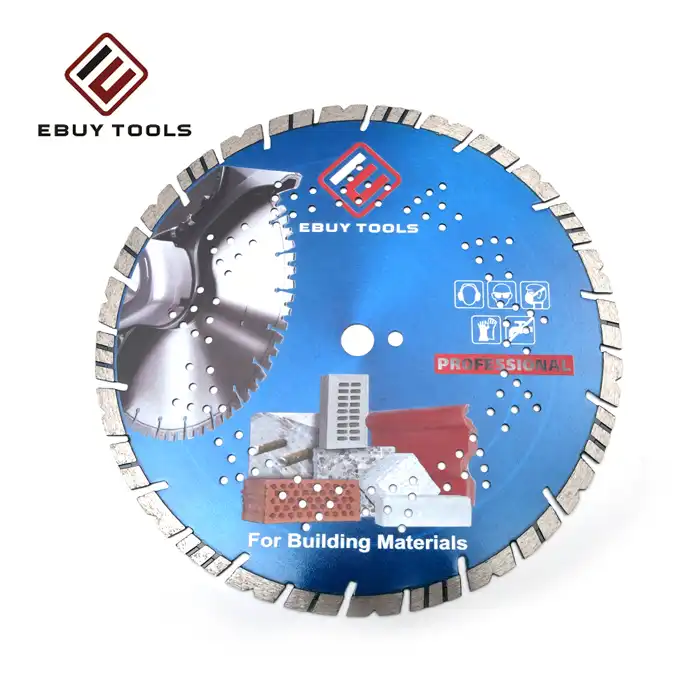
Knowing how the blade rim is made will help you choose the right tool for cutting reinforced concrete. Segmented blades have gullets (gaps) between the diamond segments that let debris escape and heat escape. This makes them perfect for dry cutting and quickly removing materials in building sites. The Continuous Diamond Saw Blade has a continuous rim that puts quality of the finish over speed of cutting. It needs to be cut wet to prevent heat buildup, but it gives you chip-free edges that are necessary for precise work.
In the middle is the Turbo Diamond Saw Blade, which has airflow channels built into its continuous castellated rim. This mixed design avoids the trade-off between efficiency and finish by including cooling lines that remove sludge while keeping the structure stable for fast cutting. The turbo setup reduces heat buildup just by its shape, so it doesn't need constant water feeds and makes better cuts than standard segmented designs.
Bonding Technologies That Drive Performance
How the diamond bits are attached to the blade core has a big impact on how well it cuts and how long it lasts. In traditional sintered blades, diamonds are physically embedded in a metal powder matrix while the blade is being compressed at high temperatures. The Hot Pressing Diamond Saw Blade goes even further by sintering and pressing at the same time. This makes pieces with higher densities that last 30 to 50 percent longer than cold-pressed blades that press and sinter independently.
Brazing Diamond Saw Blade technology is an advanced way to make things that bonds synthetic diamond grinds, active filler metals (usually Ni-Cr-B alloy), and the steel core in a strong chemical and mechanical way. This vacuum brazing method lets diamond exposure heights reach 70–80% of particle diameter. This stops diamonds from pulling out too soon when cutting hard materials and stops the glazing effect that dulls sintered bonds when cutting with low abrasion. This makes aggressive dry cutting efficient while reducing friction and heat production. This is especially helpful when cutting through parts that are strengthened with steel.
Wet Versus Dry Cutting: Matching Technology to Environment
Wet or dry cutting technology will work better for you depending on where you're cutting and what kind of tools you have. Wet cutting uses water as a coolant to clean out waste, cut down on dust, and control heat. This makes the blade last much longer while keeping the cutting precise. Continuous rim blades can't be used dry because they don't have any expansion holes to let heat escape. Cutting them dry leads to quick overheating, core bending, bond glazing, and possibly catastrophic failure.
Diamond saw blade dry cutting is easy to move and doesn't require managing water, which is helpful in places where getting rid of sludge is hard. When dry cutting, hot-pressed blades work best because their high-density segments transfer heat well and keep the diamond saw blade's diamonds in place even when they are under a lot of thermal stress. During long dry cutting sessions, letting the blade spin easily every minute or so while it cools down helps it last longer. When cutting dry, segmented and turbo designs usually work better than continuous rim designs. However, when conditions allow, wet cutting increases cutting speed and diamond saw blade life.
How to Choose the Best Diamond Saw Blade for Reinforced Concrete
To choose the best diamond saw blade, you have to weigh a number of scientific and operational factors against your unique needs for cutting reinforced concrete. The wrong blade choice costs money because it wears out faster, takes longer to cut, makes cuts that aren't as good, and could cause safety issues. The right choice, on the other hand, gives dependable performance and predictable running costs.
Defining Your Cutting Requirements
First, make sure you have a clear record of your cutting settings and the properties of your material. The compressive strength, aggregate hardness, and rebar density of reinforced concrete vary a lot. For normal building, they range from 3,000 to 6,000 PSI, and for unique uses, they can go up to 10,000 PSI. Concrete that is harder and has thick steel support needs blades with softer metal bonds so that new diamonds are always being exposed. Concrete that is softer, on the other hand, needs harder bonds to keep segments from wearing out too quickly.
Equipment specifications directly limit the choice of blades. Check the arbor size (the center hole diameter), highest blade width capacity, and motor horsepower of your saw. The arbor size is usually 1 inch or 20 mm for handheld saws. Large-diameter blades and active cutting are hard for equipment that isn't powerful enough, which causes blades to get stuck and wear out faster than they should.
For cutting hard materials while they are wet, the blade peripheral speed, which is found by multiplying the blade width by the spindle's RPM, should be around 30 to 40 meters per second. A 250mm (10-inch) blade usually works best between 2,800 and 3,800 RPM, but the exact range depends on the maker and the material.
Critical Purchase Criteria for B2B Procurement
Purchasing teams that are in charge of cutting tool inventories in various sites or that supply distributors need to look at more than just how well each unit works. In the market for diamond blades, where production quality directly affects consistency and dependability, brand recognition is very important. Established makers keep tighter limits on section geometry, diamond concentration, and bond formulation. This means that performance is consistent across production runs.
The amount of diamond in a section, which is measured by the percentage of diamond bits by volume, affects both how well it cuts and how long it lasts. Higher amounts usually make cuts smoother and last longer, but they need more motor power and may cut more slowly at first. Lower amounts cut more quickly and use less power, but the finish may not be as good and the blades may wear out faster.
A dry diamond disc can help offset slower initial cutting in high‑concentration blades by providing extra aggressive surface exposure during the first few passes. The best performance‑to‑cost ratio is reached by matching the concentration to the properties of your reinforced concrete and the powers of your tools.
Segment height and width influence blade life and cutting capacity. The longer pieces have more diamond material in them, which makes the blade last longer before it needs to be replaced. Wider pieces can handle side forces better when cutting through rebar, but they also take out more material each time. When accuracy and minimizing waste are important, blade diameter affects the kerf width, which is the width of the material removed during cutting. It also affects the cutting speed, the amount of power needed, and the amount of material wasted.
Bulk Purchasing Strategies and Supplier Partnerships
Instead of just buying blades, B2B buyers can get a lot out of building strategic ties with trusted blade manufacturers. When you commit to a certain amount of work, you can often get better prices, priority booking for production, and access to technical support tools that make troubleshooting and application optimization easier. Check a possible supplier's manufacturing capacity, quality control systems, and ability to provide a steady supply across multiple transport places before choosing them.
Being able to work with current equipment ecosystems makes managing supplies easier and cuts down on the need for training. Making sure that potential blade makers have products that work with major saw brands like Bosch, DeWalt, Makita, and Hilti, which are widely used in industrial settings, will help with the integration process and keep operations running as smoothly as possible. Asking for sample blades to try in the field before placing big orders guards against problems with compatibility and performance.
Optimizing Cutting Performance and Safety with Diamond Blades
To get the most out of your diamond saw blade purchase, you need to pay attention to how it is used, how it is maintained, and how it is stored. When used wrongly, even high-end blades don't work as well as they should. On the other hand, using the blade properly will extend its life and keep the quality of the cut throughout its use.
Balancing Speed, Feed, and Blade Preservation
Cutting speed is the speed of the blade's edge in meters per second, and feed rate is how fast you move the blade through the material. Too much pushing can warm segments, cause diamonds to pull out too soon, and put too much stress on the blade core, which can crack it. If there isn't enough feed pressure, on the other hand, the blade can ride on worn segments without showing new diamonds. This speeds up the glazing effect, where the metal bond smooths out and the blade stops cutting effectively.
Optimal feed pressure produces a steady flow of fine dust (for dry cutting) or slurry flow (for wet cutting) that can't be seen sparking, too much shaking, or motor bogging. Instead of pushing the blade to move faster, operators should let it cut at its own pace. This is especially important when switching between areas of concrete and attached rebar. When the blade hits rebar, it makes hot spots that can damage pieces if the feed rate isn't changed.
Addressing Blade Glazing and Maintaining Cutting Edge
Glazing happens when the metal bond gets too tough compared to the material being cut. This stops the natural bond wear that lets new diamond bits show through. The surface of the blade gets smooth, the diamonds get hidden, and the cutting stops, even though the blade doesn't look broken. This problem happens a lot and makes operators angry, but there is an easy fix that works well: dress the blade by cutting it several times into a rough object like a concrete block or an aluminum oxide dressing stick, or use a dry diamond disc to grind off the glazed layer directly. This removes the glazed bond layer and shows the diamond grit again.
Regular blade inspection helps identify developing issues before they cause failures. Look for cracks in the segments, core bending, and uneven wear patterns in the segments. These can all be signs of problems with the machine, such as spindle run-out or bearing wear. Segment loss during cutting usually means that either the bond isn't strong enough for the job or there wasn't enough cooling, which causes thermal shock. These problems can be fixed by switching to a harder bond mixture or making the flow of water better.
Safety Protocols for Reinforced Concrete Cutting
Cutting through reinforced concrete creates serious risks that need strict safety rules. Crystalline silica dust, which is known to cause cancer, is breathed in when concrete is cut. To protect your lungs from this dangerous dust, you should wear at least N95 respirators when cutting concrete without air flow or supplied-air systems when you are exposed for a long time. Wet cutting cuts down on dust in the air a lot, but you still need to wear breathing protection.
Personal protective equipment must include safety glasses or face shields that can protect against high-speed particle impacts, hearing protection for long-term cutting tasks, and gloves that can't be cut that are made to work with equipment. Even with proper use, blades sometimes break, and diamond pieces that break off become high-speed missiles. Keep your distance from the cutting line and never use a saw with a blade guard that is broken or not placed correctly.
Proper blade installation prevents accidents and equipment damage. Make sure that the arrows on the blade and saw body point in the same direction as the blade's movement. Installing the blade backwards can cause it to get stuck and possibly kick back. Tighten the arbor nut firmly with the right tools, but don't tighten it too much; that could crack the blade core or make it harder to remove the blade. Set up and set the new blades correctly by letting them run at full speed for 30 to 60 seconds before you start cutting.
Conclusion
To get the best results when choosing and using diamond saw blades to cut reinforced concrete, you need to balance technical specs, working needs, and cost. Knowing the different types of blade configurations—from split designs that focus on speed to continuous rim blades that offer precision—helps you choose the right tool for the job.
Technologies used in manufacturing, such as hot pressing and vacuum brazing, have a direct effect on performance and durability. Proper cutting methods and upkeep will keep a blade's value high throughout its useful life. Cutting tool procurement can be turned from a transactional necessity into a strategic advantage that supports organizational excellence by building relationships with dependable providers who offer expert support, consistent quality, and quick service.
FAQ
What distinguishes wet cutting from dry cutting diamond blades for reinforced concrete?
Wet cutting blades need water coolant to handle heat, clean out debris, and extend blade life, making them essential for continuous rim designs that don't have heat drainage holes. These blades last longer and make better cuts, but they need infrastructure for managing water. Dry cutting blades, which are usually segmented or turbo-shaped, have gullets that let air flow and waste escape without using water. They are easier to move around and don't require slurry removal, but they make more dust and usually wear out faster than wet cutting uses of the same type.
Can diamond saw blades be sharpened when cutting performance declines?
Diamond blades don't really need to be sharpened, but they often do better after being dressed when they glaze over. Glazing happens when the metal bond gets too smooth to show new diamonds. This stops the cutting action even though there are still enough diamonds left in the stone. Cutting through rough things like a concrete block or an aluminum oxide stick to "dress" the blade removes the glazed bond layer and reveals the diamond particles again, returning cutting performance without the need for special tools.
How do I select appropriate blade diameter and thickness for my reinforced concrete application?
The width of the blade should match the capacity of your saw and the depth should be right for your needs—a 12-inch blade cuts about 4 inches deep, taking into account the space between the blade guard and the arbor. Make sure that your saw's motor has enough horsepower for the blade's width and the job. Equipment that isn't powerful enough can cause the blade to get stuck and wear out quickly. The thickness of the blade affects the kerf width and the speed of the cut. Thinner blades take less material and cut faster, but they may bend more when they hit rebar. On the other hand, thicker blades are more stable in heavy-duty situations.
Partner with Ebuy Tools for Your Reinforced Concrete Cutting Solutions
At Danyang Ebuy Tools Co., Ltd., we manufacture premium diamond saw blades specifically engineered for reinforced concrete applications across metalworking, automotive, aerospace, and construction sectors. Our 77,000-square-meter production facility produces approximately 150,000 diamond saw blades daily, combining substantial manufacturing capacity with rigorous quality control systems that ensure consistent performance across every production batch.
Our engineering team develops customized blade solutions matching your specific reinforced concrete characteristics, equipment platforms, and operational requirements—whether you need segmented blades for fast dry cutting, continuous rim designs for precision wet cutting, or turbo configurations balancing speed and finish quality.
As a dedicated diamond saw blade manufacturer serving B2B clients worldwide, we support distributors, tooling wholesalers, and industrial end-users with competitive volume pricing, technical consultation, and responsive customer service. Our product range remains compatible with major equipment brands including Bosch, DeWalt, Makita, and Hilti platforms, simplifying integration into existing operations. Reach our procurement specialists at [email protected] to request product samples, discuss your reinforced concrete cutting challenges, or receive detailed quotations tailored to your volume requirements and delivery schedules. Let our manufacturing expertise and commitment to quality support your cutting performance objectives and operational success.
References
1. Konstanty, J. (2012). Powder Metallurgy Diamond Tools. Oxford: Elsevier Science.
2. Tönshoff, H.K., & Warnecke, G. (1982). "Diamond Tools in Stone and Civil Engineering Industry: Cutting Principles, Wear and Applications." Annals of the CIRP, 31(2), 773-776.
3. Xu, X., Li, Y., & Malkin, S. (2001). "Forces and Energy in Circular Sawing and Grinding of Granite." Journal of Manufacturing Science and Engineering, 123(1), 13-22.
4. Ersoy, A., & Atici, U. (2004). "Performance Characteristics of Circular Diamond Saws in Cutting Different Types of Rocks." Diamond and Related Materials, 13(1), 22-37.
5. Wright, D.N., & Cassapi, V.B. (1985). "Factors Influencing Stone Sawability." Industrial Diamond Review, 45(518), 84-87.
6. Polini, W., & Turchetta, S. (2004). "Force and Specific Energy in Stone Cutting by Diamond Mill." International Journal of Machine Tools and Manufacture, 44(11), 1189-1196.