.webp)

Learning the right way to use a diamond cutting disc has a direct effect on how well it cuts, how long the tool lasts, and how much money the project makes total. The best way includes choosing the right equipment, controlling the feed rates, using the right cooling methods, and making sure that all of the equipment is properly calibrated. When workers match the cutting speed to the hardness of the material and keep the pressure on the tool without pushing it too hard, they get better cuts and less tool wear. Wet cutting works better on thick materials like reinforced concrete and marble, while dry cutting is better for situations where you need to be mobile. When you understand these basic ideas, you can change cutting processes from fixing problems after they happen to optimizing them before they happen. This will lead to measured improvements in production throughput and cost management.

Understanding Diamond Cutting Discs: Basics and Types
For cutting jobs in industry, you need tools that can handle a lot of stress and still work accurately. The cutting edge of these discs is made up of synthetic diamond pieces that are bonded to metals. This makes a superabrasive surface that can cut through materials that regular abrasives would quickly wear down. The connecting matrix, which is usually made of cobalt, copper, or iron, wears away slowly during use, revealing new diamond bits that keep cutting the disc for as long as it lasts.
Structure and Composition
Precision-tensioned steel bodies in the core design keep the bodies flat even when they're rotating at high speeds. Diamond particles with grits between 30 and 50 are spread out in the segment matrix at certain amounts to remove material aggressively. Our hot-pressed sintering technology at Danyang Ebuy Tools makes sure that the diamonds are evenly spread across the cutting edge. This is a key part of avoiding uneven wear patterns that shorten the tool's useful life. Every time we make a new batch of products, our quality control system checks the diamond concentration by using spectroscopy analysis. This makes sure that all tens of thousands of units made every day in our 77,000-square-meter building work the same way.
Common Disc Types by Application
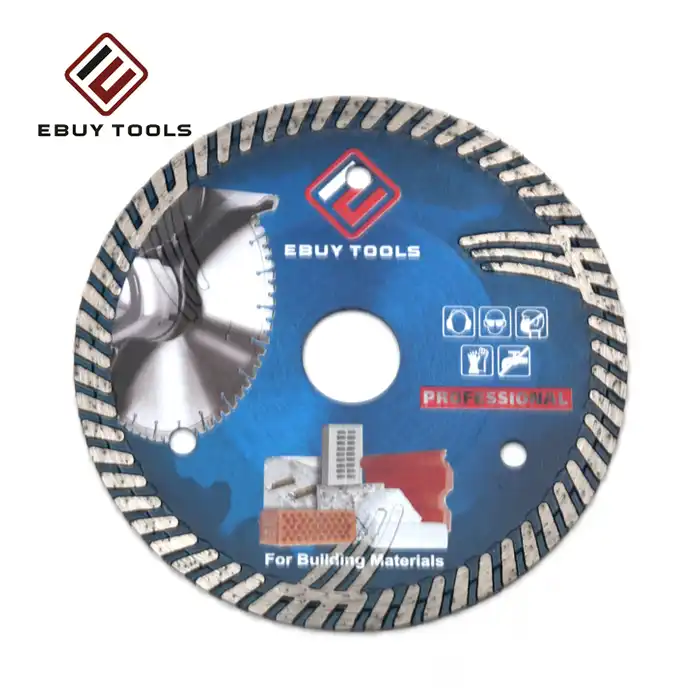
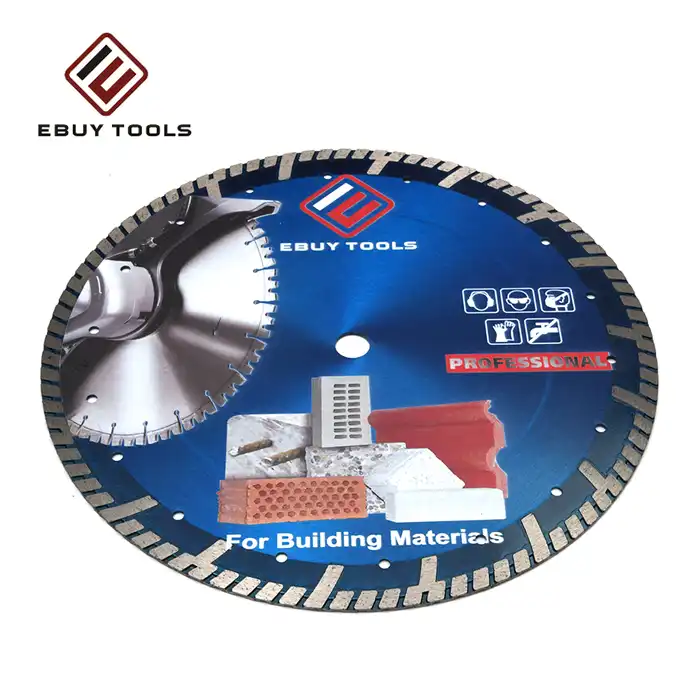
Material properties determine which disc to use. To cut concrete, you need pieces with weaker links that wear away quickly, leaving sharp diamonds to cut through the cement and aggregates. When it comes to granite and marble, stronger ties that don't eat away at crystalline structures are needed. Specialized adhesives are used in metal cutting uses to stand up to the heat that is created when steel rebar is cut through concrete. As an example of an advanced hybrid design, the Turbo Diamond Cutting Disc has serrated continuous edges that increase cutting pressure and integrated channels that improve airflow and waste evacuation. This solves the industry's long-standing problem of finding the right balance between speed and finish quality.
Wet Versus Dry Cutting Methods
Different ways of cooling have big effects on how well something works. Wet cutting creates a flow of water that gets rid of frictional heat. This stops disc cores from warping and segments from being lost due to thermal expansion. This method works well for sets with fixed equipment where slurry control systems take care of debris. Dry cutting makes it easier to move around on building sites where water access is limited, but it also makes the working temperature much higher. The turbo edge design lets natural air flow, which lowers heat buildup in dry situations and increases the time between required cooling breaks. In dry situations, our engineering tests show that turbo segments keep cutting speed 40% longer than flat continuous rim designs.
Safety Protocols and PPE Requirements
Operational risks for a diamond saw blade require a wide range of safety steps. When discs join in deep cuts, kickback events can happen, which could lead to serious injuries. Failures that are very bad can be avoided by following the right mounting steps, such as checking the torque on the arbor nuts and making sure that the highest RPM ratings match the equipment's specs. As required by ANSI Z87.1 guidelines, operators must wear impact-resistant eye protection, hearing protection when working for long periods of time at noise levels above 85 decibels, and cut-resistant gloves when changing discs. Our carefully balanced production process reduces vibrations that make operators tired and make it harder to handle equipment, making workplaces safer in a wide range of demanding industrial settings.
Best Techniques for Using Diamond Cutting Discs
Performance problems in cutting processes are usually caused by three things that are linked: incorrect feed rates, poor cooling, and incorrect equipment calibration. To solve these problems, we need to use organized methods that take into account the features of the materials, the limitations of the tools we have, and the needs of the operation.
Identifying Common Cutting Challenges
When workers put too much lateral pressure on the disc, they push it through materials instead of letting diamond grinding do the work. This leads to premature segment wear. If bond matrices don't erode properly, they clean the surface of the item instead of cutting it. This is called glazing. Continuous operation without breaks for cooling leads to overheating, which warps the steel core and makes it wobble during spinning, which is dangerous. According to procurement managers, these problems often shorten the expected lifespan of discs by 60%, which has a big effect on operational budgets in production settings with a lot of discs.
Optimizing Feed Rates and Cutting Pressure
Cutting efficiency is based on the link between feed rate and material roughness. When reinforced concrete has hard materials like quartzite, it needs to be fed more slowly—about 2 to 4 inches per minute—so that the diamond bits have enough time to break up the crystal structure. Brick and block, which are softer, can handle speeds of up to 8 to 12 inches per minute. Operators should listen to the cutting sound. High-pitched screaming means the machine is going too fast or not applying enough pressure, while hard grinding means the machine is applying too much force or the disc is glazed and needs to be dressed. The turbo segment design takes these factors into account with its toothed edge, which controls cutting pressure by raising contact points while keeping material removal rates under control.
Wet Cutting for Maximum Performance
In tough situations, water supply devices change the way cutting works. Flow rates of 0.5 to 1 gallon per minute are good for cooling without making too much slurry that makes it hard to see the cut lines. Water stops the production of silica dust, which is very important for health reasons because breathing in solid silica for a long time can cause silicosis. We tested our Turbo Diamond Cutting Disc on Class 5 granite slabs and found that cutting while wet extended the life of the segments by 18% compared to dry operations, while keeping the edges smooth, which is important for precise construction work. The continuous rim design stops section slicing, which happens a lot when cutting wetly and aggressively.
Proper Equipment Mounting and Calibration
Verifying arbor compatibility stops fatal breakdowns before they happen. The disc's bore width must exactly match the spindle's specs. Using reducer bushings causes an imbalanced spinning that speeds up wear and causes dangerous vibrations. The fastest speeds that can be written on disc cores should never be faster than what the tools can handle. For example, a 4-inch angle grinder usually works at 13,000 RPM, which is about 80 meters per second on the ground. The way we make things includes dynamic balance tests that make sure the parts are concentrically aligned within a limit of 0.02 mm. This makes sure that the machines run smoothly across their rated speed ranges. When reviewing supplier offers, procurement specs should make sure that these factors are checked.
Real-World Performance Analysis
After having disc consumption rates that were too high with diamond cutting blade, a contract manufacturing plant that made structural parts for cars made systematic changes to their methods. They made feed rates consistent by trying the materials, required wet cutting for all jobs that went on for more than three minutes straight, and started checking the equipment's accuracy every day. During a six-month review time, their operating data showed that disc consumption went down by 47%, cutting throughput went up by 32%, and parts that couldn't be used because of poor edge quality went down by 89%. In industrial settings, these measured gains led directly to lower costs and more reliable production, showing that using techniques correctly pays off in real ways.
How to Choose the Right Diamond Cutting Disc for Your Procurement Needs?
The selection factors go beyond the cost of the original purchase. To figure out the total cost of ownership, you need to know how long the machine is expected to last, how fast it cuts, how much care it needs, and how long it takes to change the tools. When buying things, choices that focus on saving money up front often lead to much higher running costs because of failures and lost output.
Defining Your Cutting Scenario
Material makeup research is the basis for making smart choices about what to buy. The type of aggregate in concrete has a big effect on how hard it is to cut. Limestone aggregate cuts easily with softer bond discs, but river rock aggregate with quartz needs stronger bonds and higher diamond concentrations. Depending on the thickness, either constant cutting or multiple passes will work better. For tasks that need precise edge quality, like making ornamental stone, expensive continuous rim or turbo designs are worth the extra money they cost at first. Job shops that work with a lot of different materials can benefit from turbo setups that are flexible and work well with a wide range of substrates without needing to change the discs often.
Critical Technical Specifications
The diameter and tree size are basic factors that determine harmony. Standard power tool designs fit common sizes, such as 4 inches, 4.5 inches, 7 inches, and 14 inches. Cutting width and material waste are affected by segment thickness. Thinner segments lower kerf loss in expensive materials like rare marble. While bond hardness grades aren't always the same from one maker to the next, they usually follow a soft, medium, or hard scale that matches the hardness of the material. Ratings for speed, given in RPM or meters per second, set safe limits that must be compatible with the equipment that is accessible. Our technical specification sheets include detailed information about all the parameters that are needed to make smart purchasing choices for a wide range of applications.
Comparing Manufacturer Capabilities
When it comes to specialized uses, well-known names still have large product lines, and their prices reflect their premium positions. When it comes to standard uses, regional makers often offer similar technical performance at more competitive prices. Supply dependability is directly affected by manufacturing capacity. Facilities that make tens of thousands of units every day keep inventory levels stable and wait times short. About 150,000 diamond saw blade pieces are made every day at Danyang Ebuy Tools, which has 319 trained workers and strict quality control systems that make sure all of the products meet the same standards, even when they are ordered in large quantities. This manufacturing scale makes flexible delivery schedules possible, which is important for meeting project deadlines in industry buying settings.
Warranty Coverage and Support Services
Warranty terms for a diamond saw blade range a lot from one seller to the next, which shows how confident the maker is in the product's durability. Standard coverage covers problems with the way the product was made, like segments coming off, the core shifting, or irregularities in the arbor hole, but not standard wear and tear or damage from abuse. When fixing speed problems in specialized applications, having access to technical support is very helpful. The research and development department at our company keeps in touch with the procurement teams directly and makes suggestions based on trying materials and analyzing working parameters. This consultative method cuts down on the time and money needed to try different setups until you find the best one for a complicated cutting situation.
Maximizing Return on Investment
Lifecycle cost analysis for a diamond saw blade makes it clear what the real value ideas are. A premium disc that costs 40% more than normal options but has a 150% longer operating life and a 25% faster cutting speed saves a lot of money in the long run because it cuts down on downtime, lowers labor costs, and boosts throughput. Bulk buying programs with well-known suppliers can often get you better prices based on volume while keeping the supply chain running smoothly. Specialty applications that work with hard materials like titanium or superalloys should buy specially made discs with higher diamond concentrations and advanced bond formulations because they work better and prevent expensive damage to the workpiece and rework costs that can happen when the wrong tools are used.
Procurement Insights: Buying Diamond Cutting Discs Online and Wholesale
Digital buying platforms give buyers more access to suppliers, but they also make authentication harder. When fake goods don't have the right amount of diamonds or use steel parts that aren't up to par, they pose safety risks and don't work right, which damages equipment and delays projects.
Identifying Trustworthy Suppliers
Baseline signs of trustworthiness come from building certifications that verify the manufacturer. ISO 9001 quality management approval shows that processes are controlled in a planned way, and industry-specific standards, such as EN 13236 for sharp tools, show that safety rules are being followed. Direct ties with manufacturers get rid of the markups that distributors add, and they also let you make changes to the product specs to fit specific needs. Procurement teams that are doing supplier qualification checks can still look at our building paperwork, which includes data on our manufacturing capacity and quality control procedures. Audit reports from a third party provide extra proof of claimed skills and output standards.
Understanding Pricing Components
The prices of materials change depending on the specs of the steel substrate, the price of synthetic diamonds, and the bond matrix formulas. The number of segments and their height are directly related to how hard it is to make and how much raw material is used. Specialized designs with high-tech features like laser-welded pieces or vibration-dampening cores cost more, but their better performance makes up for it. Volume-based price systems usually go into effect when an order exceeds 100 units, with discounts getting bigger at 500, 1000, and 5000 units. Seasonal trends in demand lead to sales possibilities, especially during slow building times when companies try to keep up production through price reward programs.
Logistics and Lead Time Management
Manufacturing lead times range from being available right away for standard setups to taking several weeks for special specs that need tooling changes. Customs paperwork, figuring out duties, and longer delivery times make international shipping even more complicated. Trustworthy sellers keep extra stock of regular product lines, which lets urgent needs be met quickly. Our logistics coordination team handles export paperwork and shipping plans, making sure that all foreign trade rules are followed and that consolidated packages get the best freight rates. Setting up framework deals with chosen suppliers makes it easier to place repeat orders and makes sure that you get priority during times of high demand when supply problems happen across global markets.
Certification and Authenticity Verification
Product certifications include more than just what the maker says; they also include proof from independent tests. Safety signs that show agreement with OSHA and European CE standards show that the right testing procedures were followed. Destructive testing to check the diamond concentration is the only way to be sure of its authenticity, but it's not practical for regular purchase proof. Building long-term ties with makers that consistently produce high-quality goods makes authentication easier and increases the stability of the supply chain. Our thorough testing records come with all of our shipments. These records include segment torque measures, core run-out specs, and diamond concentration analysis results that show proof of quality that meets purchase compliance requirements.
Conclusion
Using the right methods for operating a diamond cutting disc turns difficult cutting tasks into managed, repeatable processes. Controlled feed rates that are matched to the qualities of the material, the right way to cool it, and regular equipment testing get rid of the main reasons why things wear out and stop working well. It is more valuable to make purchases based on detailed technical specs and a total cost of ownership study than to buy something based only on the price at first. The advanced engineering used in turbo edge designs overcomes long-standing problems in the industry, offering flexible options for a wide range of cutting tasks. As manufacturing technology keeps getting better, staying up to date on new capabilities and techniques gives companies a competitive edge by making their operations more efficient and lowering costs in tough industrial settings.
FAQ
How long should a diamond cutting disc last under normal operating conditions?
Lifespan changes a lot depending on how hard the material is, how it is cut, and how it is cooled. When cutting concrete the right way, 15 to 30 linear feet of segment height are usually gained for every inch of segment height. This is cut down to 8 to 15 linear feet for harder materials like marble. When compared to wet uses, dry cutting cuts the usefulness by about 40%. The self-sharpening feature of good discs keeps the cutting speed constant over their entire working life, up to the point where the segment height hits about 2 mm. At this point, replacing the disc stops core damage and dangerous working conditions.
Can the same disc work for both wet and dry cutting applications?
Because of its clever thermal control design, the Turbo Diamond Cutting Disc meets this need for flexibility. The continuous serrated edge makes airflow paths that get rid of heat when the system is not being used and keep the structure strong when water cooling is used. For best results, though, you need to use the right method for the job. For example, wet cutting on high-density materials keeps them from burning and greatly increases their lifespan, while dry cutting is better for portable uses where water delivery systems aren't practical. Bond formulas that work best when they're wet may glaze over too quickly when they're dry, which makes cutting less effective.
What safety measures are most critical when operating diamond cutting discs?
Making sure that the highest RPM rates are the same as or higher than what the equipment says is needed to keep the disc from breaking completely due to centrifugal forces. When arbor nuts are properly torqued and mounted, the disc won't slip during operation. By letting newly placed discs run at full speed for 30 seconds without any load, any balance or fastening problems can be found before they engage material. Binding and kickback can be avoided by cutting at the right angle, which is usually 90 degrees to the work area. Checking the disc regularly for section damage or core bending finds wear patterns that mean the disc needs to be retired before dangerous failure modes happen during operation.
Partner with a Trusted Diamond Cutting Disc Manufacturer
Danyang Ebuy Tools offers cutting solutions that are precisely designed and are backed by a large production capacity and strict quality standards. The Turbo Diamond Cutting Disc we make uses both hot-pressed sintering technology and precision-tensioned steel cores. It can safely go up to 80 meters per second. With 319 skilled workers spread out over 77,000 square meters of space and the ability to make 150,000 pieces every day, we make sure that supply chains for demanding industrial procurement needs are reliable. Get in touch with our expert team at [email protected] to talk about application-specific suggestions and prices for large orders. We offer custom solutions that deal with unique material problems and keep delivery times that are competitive and support your project's timelines and business goals.
References
Jackson, M. R. (2021). Advanced Abrasive Technology in Industrial Material Processing. Industrial Manufacturing Press.
Thompson, K. L., & Rodriguez, P. A. (2020). Diamond Tool Engineering: Principles and Applications for Hard Material Cutting. Technical Publishing International.
Chen, W. (2022). "Performance Optimization of Superabrasive Cutting Tools in Composite Material Machining." Journal of Manufacturing Science and Engineering, 144(8), 081002.
Anderson, J. T. (2019). Procurement Strategies for Industrial Cutting Tools: A Comprehensive Guide. Supply Chain Management Publications.
Williams, D. S., & Kumar, R. (2021). "Thermal Management in High-Speed Diamond Cutting Operations." International Journal of Machine Tools and Manufacture, 163, 103-118.
Morrison, A. B. (2020). Safety Standards and Best Practices for Abrasive Wheel Operations. Occupational Safety Technical Institute.