.webp)

Diamond polishing discs are specialized abrasive tools engineered to deliver superior surface finishing on hard materials including granite, marble, concrete, and engineered stone. These precision instruments utilize industrial-grade synthetic diamond particles embedded within high-performance resin, ceramic, or metal matrices to achieve mirror-like finishes that traditional abrasives cannot replicate. Unlike conventional sanding materials that struggle with materials exceeding Mohs hardness 7, diamond polishing discs provide aggressive material removal combined with exceptional durability, making them indispensable for stone fabrication shops, concrete restoration contractors, and precision manufacturing facilities seeking consistent quality and operational efficiency.
Understanding Diamond Polishing Discs: Types, Benefits, and Core Applications
Understanding what makes these specialized tools different from regular abrasives is the first step to finishing surfaces well. A diamond polishing disc is made up of micron-sized diamond powder that is held together by a carefully designed matrix that controls how fast the diamond wears down and how much heat it transfers. This construction addresses critical industry challenges that procurement managers and production engineers face daily.
Bond Matrix Variations and Their Impact on Performance
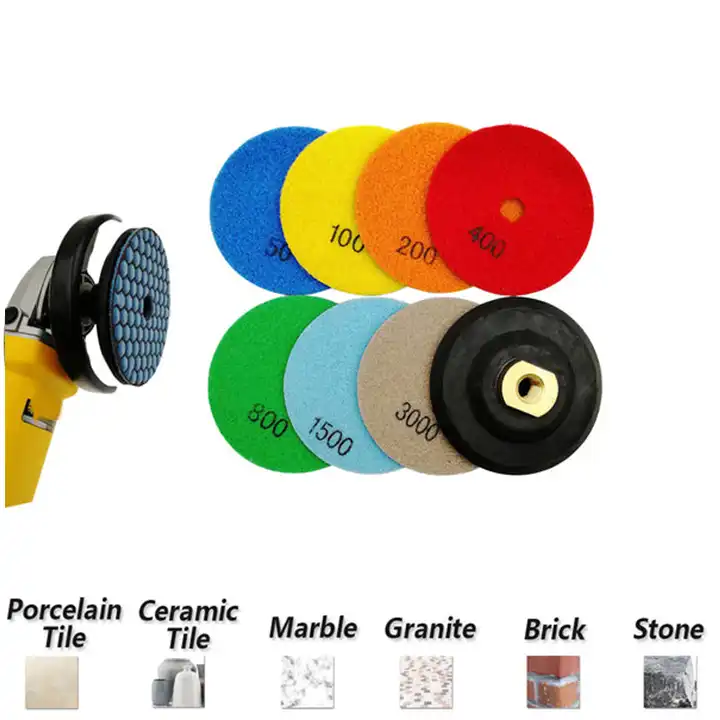
How hard the disc cuts and how long it lasts under certain situations are both controlled by the bonded matrix. Resin-bonded types work best for fine polishing steps from #400 to #3000 grit. They are flexible enough to work with curved surfaces and edge shaping while staying below 180°C. Metal or copper-bonded choices give you the rigidity you need for rough grinding jobs from #30 to #200 grit, as well as the heat protection you need for heavy-duty uses. Ceramic and mixed matrices fall between these two groups. They provide transitional performance that gets rid of deep scratches left by rougher metal-bonded steps and gets surfaces ready for the final resin-based finishing.
During the production process at Ebuy Tools, structured cooling pathways are built into the design of every disc. Burn marks show up on expensive granite and quartz surfaces when heat control isn't done right, which costs a lot to fix. The designed groove designs make it easier for heat to escape and slurry to drain, which protects the workpiece and makes the tool last a lot longer than solid-backing options.
Material Compatibility and Grit Selection Strategy
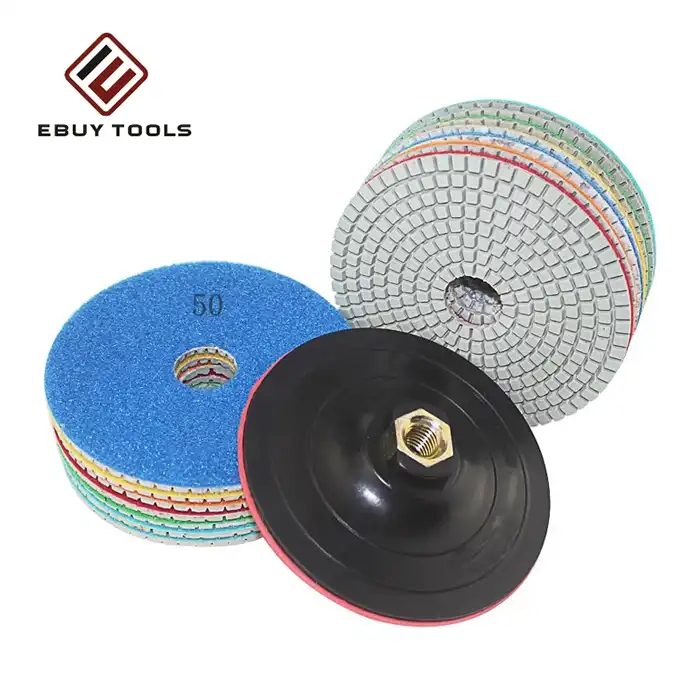
To get the best results with different materials, you need to use different methods. A seven-step grit progression is usually needed to make a granite tabletop. The first step is #50, which is used to remove lippage, and the next steps are #100, #200, #400, #800, #1500, and finally #3000, which is used for the final mirror shine. Similar ideas are used for restoring concrete floors, but semi-rigid puck forms that work with planetary grinding tools are often used. When working with marble and other soft stones, you need to be more careful and use white or neutral resin ties to keep the color from bleeding into the stone's pores.
It's impossible to say enough good things about the idea of sequential grit development. When you skip grit steps to save time, you always end up with ghost scratches, which are deep flaws in the surface that smaller grits can't get rid of. When this happens, surfaces look shiny, but they are still scratched when the lighting is right. Professional makers follow the rule that they should not skip more than one grit level to keep the surface quality their clients expect.
Measurable Performance Advantages
The main economic gain is a long working life. Because they self-sharpen, high-quality discs keep cutting well for a long time. This is because the matrix wears away at controlled rates, revealing new diamond cutting edges all the time. This keeps frosting from happening, which is when diamonds get stuck under old matrix material and can't cut as well.
There are several ways that cost saves add up. In high-volume work settings, less slowdown is caused by tool changes. A longer tool life means less money spent on abrasives per piece. Reject rates from surface flaws go down when performance is consistent. When purchasing teams look at the total cost of ownership instead of the original purchase price, it's easy to see that better goods give a clear return on investment.
How to Use Diamond Polishing Discs Effectively: Operational Best Practices?
To get specification-grade results and get the most out of your tools, you need to do more than just attach a diamond polishing disc to a polisher.
Pre-Operation Tool Selection and Inspection
Successful operations depend on matching the disc's specs to the material's properties. For example, quartzite needs bonding matrices that are harder, while softer stones need formulas that are softer. Wet or dry-use setups depend on the operating environment. Using discs that are labeled for wet use in dry situations causes the glue to fail right away and the surface to burn.
The hook-and-loop backing should be checked for wear before every shift. The most common place where this connection interface fails is where it peels off too easily. When a disc comes off at 4000 RPM, it poses a major safety risk and damages the workpiece. By checking the balance, you can avoid shaking problems that wear out operators and leave chatter marks on finished surfaces.
Structured Polishing Process Execution
A controlled grit development leads to good polishing. Starting with coarse grits gets rid of material quickly, but it leaves behind scratch marks that can be seen. With each step, the grit gets smaller, removing the scratches from the previous step while adding its own finer design. The process keeps going until the scratch pattern can't be seen with the naked eye. This is usually reached at grits #1500 to #3000, but it depends on the material and the lighting.
The operating factors have a big effect on the results. For most hand-held tasks on stone counters, keeping the rotating speed between 2000 and 4000 RPM works well. Going faster than 5000 RPM creates too much heat that doesn't help remove material faster and actually breaks down resin bonds too soon. When applying pressure, you need to find the right mix. Too little pressure makes things less efficient, while too much force speeds up wear and makes heat.
In wet cleaning, water cooling is used for more than one thing. Aside from controlling the temperature, the water slurry also gets rid of bits of removed material that would otherwise scratch the surface and block the diamond abrasive. The constant flow keeps the cutting conditions the same throughout the process.
Maintenance Protocols That Extend Tool Life
Cleaning the discs after each use gets rid of any stuck-on material that makes cutting less effective. For resin-bonded options, just cleaning them with water is enough. For metal-bonded options, you might need to brush them. Bonding stays strong as long as it is stored properly, away from too much heat and wetness. Some businesses keep dressing blocks on hand. These are rough surfaces that re-expose diamonds when discs start to glaze over, effectively cutting them for more use.
Rotation plans that switch between using different discs give them time to cool down between uses, which extends their total life. This method works especially well in high-production settings where tools could get too hot from continuous use.
Choosing the Right Diamond Polishing Disc: Decision Framework for Procurement Teams
When making strategic sourcing choices, it's important to weigh short-term costs against long-term business costs while also making sure the product is real and the supply is reliable. Matching the correct diamond polishing disc to the application requirements ensures operational success.
Bond Type Selection Based on Application Requirements
Resin mixtures are flexible enough to make complicated edge shapes like ogees, bullnoses, and decorative features that are popular in building stonework. Because of the flexibility, discs can follow curved surfaces without leaving any flat spots. These work best in the finishing stages, where getting a good surface is more important than getting rid of stock quickly.
Bonds made of metal and clay provide the strength needed for work on flat surfaces and the first stages of grinding. Because they don't break down when exposed to heat for a long time, they can be used to prepare big areas of concrete floors where constant work for hours at a time is normal.
Hybrid diamond polishing pad versions try to find a balance between these traits, giving shops that work on a variety of projects the flexibility they need without having to keep a lot of tools on hand. Managers of procurement should think about whether the need for practical freedom is worth possible performance losses in specific areas.
Grit Range Inventory Management
Complete grit patterns allow for the best results, but they raise the cost of keeping supplies. Strategic methods keep full progressions for basic materials and only keep important grits on hand for rare uses. Stone fabrication shops that make granite slabs can benefit from full seven-step sets, while concrete repair workers may focus on transition grits from #100 to #400 for the work they do.
At Ebuy Tools, our research and development team helps customers find the best grit mixtures for their specific types of materials and quality standards. This consulting service helps keep product costs low while still making sure that project requirements can be met.
Diameter and Backing System Considerations
Disc sizes range from 4 inches to 7 inches so they can be used with a variety of tools and on a range of scales. Handheld variable-speed polishers used to make countertops work best with smaller sizes. Floor tools can handle larger areas when the forms are bigger. The hook-and-loop backing method makes it easy to change discs quickly, which is important for sequential grit progression processes. Color-coded backing makes it easier to find grit when production is going quickly.
Distributors can brand goods for their markets and benefit from economies of scale at the same time by using custom logo printing. This white-label method helps with market positioning plans without needing to spend money on production equipment.
Real-World Applications Across Industrial Sectors
Learning how these tools are used in different industries sheds light on buying goals and performance needs. Professional fabricators often rely on a high-quality diamond polishing disc to meet tight project deadlines.
Stone Fabrication and Countertop Manufacturing
Granite, quartz, and marble surfaces need to have uniform edge quality for both home and business countertop output. Handheld polishers with 2000 to 4000 RPM are used in fabrication shops to smooth out edges after sink holes have been cut and artistic features have been shaped. In places where water cooling is common, the discs must keep working well even when they are wet.
Resin-bonded discs give you the freedom you need for complex shapes around undermount sink cutouts. When following bends, the strengthened backing can handle centrifugal forces without coming apart. Diamond concentration management in high-end goods makes sure that the cutting is strong during the shaping stages and that the diamonds last a long time, which makes the cost worth it in high-volume operations.
Template cutting leaves small flaws on the surface that can be fixed by cleaning, giving the installation the perfect look that customers expect from high-end ones. Professional makers decide what to buy based on how well they can get reliable results with different types and colors of stone.
Concrete Floor Restoration and Industrial Polishing
For longevity and good looks, diamond polishing pad polished concrete is being used more and more in commercial and industrial flooring projects. Planetary grinding equipment is used for this task. It has several semi-rigid plates that work together on a large surface area. The process starts with coarse grinding to reveal the aggregate, then moves on to honing stages that smooth out scratch patterns, and finally finishing stages that create high-gloss finishes.
Post-densifier application has its own set of problems. Chemical hardeners can get through the top of concrete, so they need special bonding materials that don't break down and keep the cutting efficiency. When these things happen, our ceramic-hybrid formulations can handle them without the link breaking down that leads to smearing or uneven gloss development.
In these situations, the cost savings come from higher usage rates and longer tool life. Costs for big projects are measured by the square foot instead of the tool, so how long the disc lasts and how well it works throughout its life are very important when buying it.
Terrazzo Restoration and Specialty Applications
Terrazzo is a type of hybrid flooring made from marble chips mixed with cement or epoxy. It is often used to restore historic buildings and business spaces. These kinds of projects often happen in places where people are already living, so using water would be useless because of drainage issues and worries about disturbing people.
For dry-use recipes, high-temperature-resistant plastics keep the mixture from melting when it comes into contact with frictional heat. This feature gets rid of the smearing issues that happen when regular wet-use products are used in dry conditions, which lowers the quality of the finish. The end result keeps the artistic aggregate view that makes terrazzo look good while reaching the gloss levels that make old installations look new again.
In the past few years, specialty stone products like made quartz surfaces have grown in popularity. These goods mix natural quartz bits with polymer resins to make surfaces that are very hard and can't be worn down with regular abrasives. Diamond technology works well with these materials where other ways fail or wear out too quickly.
Strategic Procurement Approaches for B2B Buyers
When making sourcing choices, it's not enough to just compare prices per unit; you also need to think about supply stability, expert support, and total running costs. Sourcing a reliable diamond polishing disc requires evaluating the manufacturer's long-term production capabilities.
Evaluating Manufacturer Capabilities and Authenticity
The scale of production for diamond polishing disc shows how stable the supply is. Our 77,000-square-meter factory, which has 319 trained workers, makes 150,000 pieces of cutting tools every day. This makes sure that we always have inventory, which keeps projects from being held up. Dedicated quality control systems make sure that every production batch meets the requirements before it is sent out. This lowers the number of rejects that slow down work and raise costs.
Research and development skills set companies that really come up with new ideas apart from those that just sell generic goods. When a customer wants a custom formulation, it is made to meet their particular needs, such as odd material combinations, special working conditions, or specific performance qualities. This method to technical partnerships gives businesses more benefits than standard catalog items.
Making sure the maker is real is the best way to avoid getting fake goods that don't work or are safe. Authorized dealer networks offer peace of mind, technical help, and guarantee coverage that you can't get from gray-market sources. The short-term savings on costs that come from shady sources often go away quickly when tools break down, work stops, or safety issues happen.
Bulk Purchasing and Supply Chain Management
Buying in bulk cuts costs in a real way and makes sure that tools are always available. When you negotiate a supply deal, you lock in the specs and delivery times that help you plan your production. Because it is predictable, it is possible to handle inventory in a way that lowers costs without running out of items during times of high demand.
Building relationships with dependable suppliers opens up lines of contact that allow for technical advice and quick problem settlement. When problems with applications come up or new materials are put into production, relationships help solve problems quickly and with as little trouble as possible.
Total landing costs are greatly affected by factors related to distribution. Combined packages save money on freight costs, and planning ahead enough to avoid paying extra for fast shipping costs. To find the right balance between inventory levels, storing costs, and capital needs, you need to look at how things are used and how much will be made.
Competitive Analysis and Value Assessment
When you compare products from well-known names like 3M, DeWalt, Bosch, Makita, and Husqvarna, you can get a sense of what to expect in terms of performance and price. But buying excellence knows that premium brands sometimes charge more for their market place than they do for better performance. Value chances can be found by rigorously trying different suppliers against objective performance measures such as rates of material removal, tool life under standard conditions, and measurements of finish quality.
Gloss meter results give a numeric measure of the quality of the finish. According to industry norms, polishing methods must achieve 90 gloss units or higher on black granite in order to be considered successful. Including these kinds of testing rules in purchase deals makes sure that goods meet practical needs, no matter what brand they are.
Conclusion
Diamond polishing discs are important pieces of equipment to buy for tasks that need to finish the surface of hard materials very well. Procurement managers and production engineers can make smart choices about where to get materials by knowing the technical differences between bond types, grit progressions, and application-specific formulas. The recommended operating best practices—from systematic grit progression to proper repair protocols—enhance the performance of tools and lower their overall costs. When you use strategic buying methods that balance the skills of the maker, the reliability of the supply chain, and thorough performance validation, you gain a competitive edge through consistent quality output and improved organizational efficiency. The many uses for these tools in stone fabrication, concrete restoration, and custom finishing show how flexible they are and how important it is to match specs to specific needs. For implementation to go well, you need both technical know-how and smart partnerships with suppliers that support long-term operating excellence.
FAQ
Can wet-designated discs be used for dry polishing operations?
Wet-use discs use water cooling to deal with the heat they make while they're working. The resin bonds in these mixtures can't handle dry-use temperatures above 200°C. This means that they melt quickly, leaving burned marks on the workpieces and separating from the backing right away. When water cooling is not available, always use diamond polishing discs that are clearly marked for dry use. The cost savings from using current goods in the wrong way are lost right away as tools and workpieces are broken.
What makes colors move to stone surfaces that are light in color?
Dark resin colors can seep into Carrara marble or white quartz, which are both porous. When standard bonds move stuff into the stone's tiny pore structure, this coloring happens. This flaw can be avoided by using white bond or neutral glue formulas that are made for light-colored materials. Specifications for buying things should require versions that don't stain for stores that deal with expensive light stones, since any staining means expensive repair.
How can I keep discs from getting cloudy and loosing their ability to cut?
Glazing happens when the bonded matrix is too hard for the object being polished. The link doesn't wear away properly, which keeps the gems below the surface, where they can't cut. This problem can be fixed by matching the bond hardness to the material hardness. If the disc starts to glaze even after being properly chosen, cleaning the surface on a rough abrasive block brings out the diamonds again and returns the cutting action, making the tool more useful for longer.
Partner With Ebuy Tools for Your Diamond Polishing Disc Requirements
Enterprise-level abrasive solutions made by Ebuy Tools are designed to meet the needs of difficult stone production and concrete finishing tasks. Our line of diamond polishing discs uses advanced synthetic diamond technology and improved bonding matrices to remove more material than other brands while protecting expensive work surfaces from heat damage. The color-coded hook-and-loop backing system makes it easy to switch between grits quickly, which is necessary for efficient sequential cleaning processes. Our 77,000-square-meter production center is home to 319 skilled workers who keep it running at full capacity, making sure that distributors and large-scale fabrication companies always have what they need. Our focused research and development team offers custom mixture services to deal with specific material problems or performance needs. Contact our team at [email protected] to talk about how our manufacturing skills and application knowledge can help your business succeed, whether you need a reliable supplier for ongoing production or want technical advice on how to make your finishing processes more efficient.
References
Smith, J. & Anderson, K. (2021). Advanced Abrasive Technologies for Natural Stone Processing. Industrial Surface Finishing Journal, Vol. 34, pp. 112-128.
Chen, L. (2020). Concrete Polishing Systems: Materials Science and Application Techniques. Construction Materials Research Institute, Technical Publication Series.
Williams, R. (2022). Diamond Abrasive Performance in Hard Material Machining. Manufacturing Technology Review, Vol. 19, Issue 3, pp. 45-67.
Thompson, M. & Garcia, P. (2019). Procurement Best Practices for Industrial Abrasive Products. Supply Chain Management Quarterly, pp. 88-103.
National Stone Institute (2023). Surface Finishing Standards for Architectural Stone Applications. Technical Bulletin NSI-2023-07.
International Concrete Polishing Association (2022). Guidelines for Mechanical Concrete Surface Preparation and Polishing. ICPA Technical Manual, 5th Edition.