.webp)

To make your diamond cutting disc last longer, you should first realize that these high-precision tools are purchases that need careful handling. Misusing an industrial diamond cutting disc in ways that can be avoided, like going too fast, not matching the material properly, or not cooling it enough, can shorten its useful life by up to 40%. When procurement managers set up structured usage rules, products often last 30 to 60 percent longer. This has a direct effect on operational budgets and production efficiency in places like precise engineering, car factories, and metalworking shops.
Understanding the Lifespan Challenges of Diamond Cutting Discs
Common Durability Issues Facing Industrial Applications
In industrial settings, overheating is still the main reason why diamond cutting disc break. When workers go over the suggested RPM limits or apply too much feed pressure, friction causes the cutting edge to get hotter than 800°F. The metal bond matrix breaks down early because of this heat stress, freeing the diamonds before they've worn all the way through. This leads to fast segment loss and uncertain cutting performance, which means that the machine has to be replaced early.
Material mismatch is another big problem that buying teams have to deal with. When you use a disc made for concrete on granite or try to cut through strengthened steel with a blade made for brickwork, the wear goes up a lot faster. On the Mohs scale, each material has its own unique hardness properties, which means that they need specially designed diamond concentrations and bond formulas. If there are mismatches, the diamonds can become hidden under worn metal, this is called glazing. If the bond wears away too quickly, the diamonds can lose their sharpness and become aggressively segmented.
Environmental and Operational Factors
The environment on construction sites can shorten the life of a diamond cutting disc in ways that are often not thought of. As dust builds up between cutting sessions, it works as an abrasive compound that harms the edges of segments while they are being stored. When steel cores are exposed to moisture, they oxidize, which makes the structure weak and increases the chance that the disc will break while it is being used. Changes in temperature between storage and use cause cycles of expansion and contraction that put stress on the bond between the pieces and the core, which could lead to delamination.
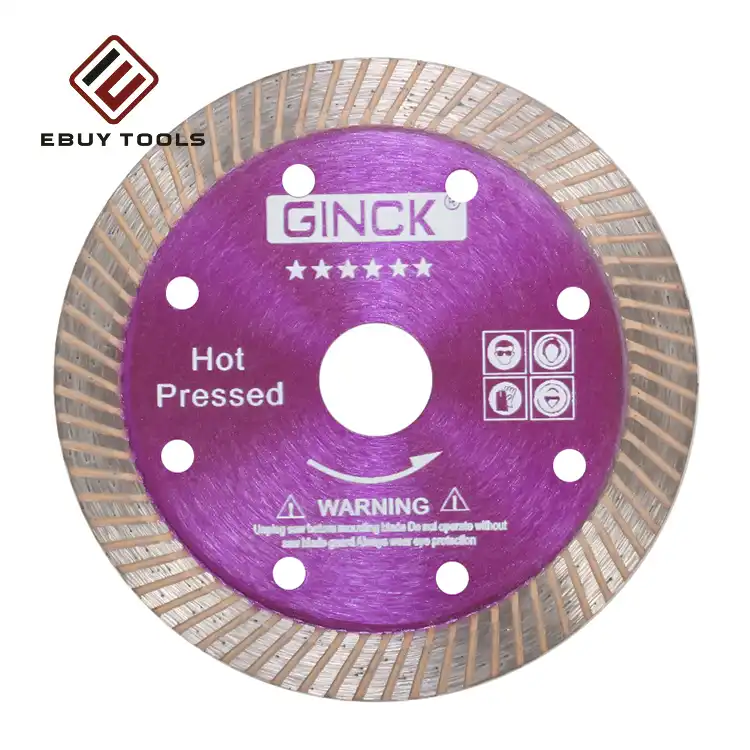
Ebuy Tools' rapid diamond cutting disc design solves these problems with heat management thanks to its unique serrated continuous margin. This design produces natural airflow pathways that get rid of heat more effectively than segmented designs, so even during long cutting sessions, the operating temperatures stay within safe limits. The safety teeth keep the disc from undercutting, which can happen when the angle isn't right. This keeps both the tool and the subject safe.
Best Practices to Extend Diamond Cutting Disc Life
Controlling Cutting Speed and Feed Pressure
Matching the diamond cutting disc specs to the equipment's powers is the first step in managing speed correctly. Each cutting disc has a highest RPM number that is based on its diameter and how tight the core is. By operating 10-15% below these limits, you can add a safety cushion while lowering the heat output. The Ebuy Tools turbo discs can safely work at speeds of up to 80m/s thanks to precision-tensioned steel cores made using hot-pressed sintering technology. However, for the best durability, they should be used within the suggested limits instead of at full speed.
Feed pressure needs discipline and training from the user. When you push the diamond cutting disc through material, it causes too much friction, which makes heat that builds up faster than air cooling can remove. Instead of applying force, the right way to do it is to let the diamond grit do the work through touch and movement. The self-sharpening system works as it should when workers keep the pressure steady and moderate. The metal bond wears away at a controlled rate, revealing new diamond edges all the time.
Material-Specific Selection Strategies
Matching the specs of the diamond cutting disc to the properties of the material is likely the most important purchase choice that affects the life of the tool. For cutting concrete, you need different amounts of diamonds and a different bond strength than for making things out of rock or cutting metal. The bond needs to wear at the same rate as the diamonds. If it's too soft, the segments will wear away too quickly, and if it's too hard, the diamonds will get hidden, making the disc shine and cut less well.
Here are the main rules for matching materials that make things last longer:
Concrete and Masonry Applications: Formulations with a medium bond work well with the grain structure of concrete. The Ebuy Tools turbo design works great here because the grooved parts make it easy for dust to escape quickly. This keeps the blade from getting stuck, which shortens its life when cutting deeply into clay steps or high-density concrete. The continuous rim design makes cuts that are smoother, and the turbo serrations keep the fast rates of material removal.
Natural Stone Fabrication: Because granite and quartzite are 6-7 on the Mohs scale, they need harder bond structures. Professional-grade turbo discs have a special diamond core that makes them last longer for Class 4 and 5 natural stones and gives them chip-free edges like continuous rim designs. This set-up lets you do precise work on thick slab profiles and clean miters without slowing down the cutting process.
Reinforced Concrete and Composite Materials: The disc must be able to cut through rebar-embedded concrete while also being able to handle steel and gravel well. The turbo edge design raises the cutting pressure at the points of contact while keeping the coolant levels up to stop segment loss when switching between materials with very different hardness levels.
These material-specific factors have a direct effect on purchasing choices, especially for businesses that deal with a wide range of materials during different project stages or client needs.
Wet Versus Dry Cutting Methods
Adding water changes the heat behavior of the diamond cutting disc in a big way. Wet cutting lowers the operating temperature by 60–70%, which greatly increases the life of the disc and stops dust from forming. The constant flow of water removes swarf that would otherwise build up and cause friction. This keeps the diamond edges clear and sharp. The Ebuy Tools turbo diamond cutting disc works best when it's cooled with water, but its self-cooling turbo design also works well for dry jobs when managing water isn't possible.
Even though it speeds up wear and tear, dry cutting is useful in some situations. Dry ways are appropriate for job sites that don't have access to water, indoor uses where controlling moisture is important, or quick cuts where setup time is more important than blade life. When cutting dry, operators must follow strict cutting intervals—30 seconds of cutting followed by 10 to 15 seconds of air cooling keeps the blades from getting too hot and breaking. In this case, the airflow paths in turbo designs are very useful because they help natural circulation cool down the engine during both cutting and rest periods.
Maintenance and Storage Recommendations
Routine Inspection Protocols
Systematic checking finds issues before they lead to failures or safety events. Operators should look at diamond cutting disc for cracks that can be seen coming from the center hole or between segments before every shift. Even very small cracks in the structure show that it is weakening, which could cause it to fail catastrophically at normal speeds. Uneven segment wear, where one part has a lot more wear and tear than the others, means that the fastening system is wobbling or not aligning properly and needs to be fixed right away.
During checks, the stability of the hub should be given extra attention. There must be no gaps or loose connections between the pieces and the steel body. Listening for changes in operational sound can help operators spot early bonding failure. Rattling or irregular vibrations can show segment movement that happens before full separation. The 77,000-square-meter factory where Ebuy Tools makes precision tools includes strict testing of segment torque and side run-out measurements. However, situations in the field can put stress on these connections over time.
Cleaning and Residue Management
When material builds up between segments and on the faces of a diamond cutting disc, it makes cutting less effective and causes more friction and heat. Technicians should use compressed air or stiff brushes to get rid of any concrete dust, stone slurry, or metal bits that have built up after each work session. To get rid of hardened residue, you need to soak it in the right cleaning solution (alkaline cleaners for concrete, acidic cleaners for mineral deposits), rinse it well, and let it dry.
The turbo design's serrated edges make cleaning easier than with split blades that are deeply buried. The open channel design keeps trash from getting packed down in places that are hard to get to. This upkeep benefit grows over the disc's useful life, since sharper performance is maintained with less work from the user when the cutting edges are kept clean.
Storage Environment Controls
Managing the surroundings is the first step to good keeping for a diamond cutting disc. When the humidity is above 60%, the steel core oxidizes. This is especially true around the hole, where protective coats may have worn off during mounting and dismounting. Stable temperature is just as important—storage places with big changes in temperature cause stress from expansion and contraction that can weaken segment bonds or bend thin cores.
Edge damage can be avoided by storing the discs in a way that keeps them balanced. Putting discs away on hangers keeps them from rubbing against each other, which can break pieces. When stacking is necessary because of limited room, protective sleeves or cardboard dividers keep the discs from touching each other. The 319 skilled workers at Ebuy Tools make sure that every disc leaves the building in secure packaging that will keep its quality while it's being shipped and stored. However, it is the end user's duty to keep these standards in warehouses.
How discs are handled in the warehouse has a direct effect on how long they last. Procurement managers who are in charge of large orders should set rules that discs should not be handled carelessly. For example, discs should never be used as makeshift surfaces or leaning against rough walls. Designated storage racks with individual slots keep goods organized so that it can be rotated. This reduces moving and touch.
Choosing Diamond Cutting Discs for Durability and Performance
Technical Specifications That Determine Longevity
The grit size shows the size of the diamond particles that are set in the cutting pieces of the diamond cutting disc. Coarser grits (30–50) remove material quickly but leave a rough surface, while finer grits (200–400) make cuts that are smooth but require more feed rates. The choice has a direct effect on wear rates; forceful cutting makes more heat and uses up diamonds faster, but it takes longer to finish the job. These trade-offs have to be weighed in procurement choices based on the needs of the application and the goals of operations.
The strength and cutting accuracy of a diamond cutting disc are affected by the disc's width. When cutting deeply, thicker discs don't bend as easily, so the cuts stay straighter. However, they take more material as kerf waste and need more power to run. The precision-tensioned steel cores in Ebuy Tools' turbo discs make the best use of this balance, giving them enough stiffness for precise cuts while keeping the kerf width as small as possible to cut down on waste and power use.
How the metal mesh lets the gems go during cutting depends on the type of bond. It is possible for soft bonds to stick to hard materials because the rough base wears down the bond quickly, revealing fresh diamonds. When the base won't wear away the matrix enough, hard ties work best with softer materials. Professional-grade turbo discs from Ebuy Tools have a carefully designed bond matrix that gives them the best wear qualities for all the different cutting tasks that happen in metalworking, auto manufacturing, and building.
Comparative Analysis with Alternative Cutting Technologies
In some situations, a diamond cutting disc is used in place of carbide-tipped blades and grinding wheels. Carbide blades are cheaper to buy at first, but they wear out much faster when cutting stone or brickwork, so they are only cost-effective for cutting wood and soft metals. Abrasive wheels cut quickly, but they also wear out quickly, which means they need to be replaced often and create a lot of waste.
When it comes to hard materials, diamond technology has a lower total cost of ownership. The longer service life—often 50–100 times longer than abrasive wheels when cutting concrete—justifies the higher original investment by cutting down on downtime for tool changes, lower waste costs, and less work for managing the blades. Ebuy Tools can make 150,000 pieces every day, which guarantees a steady supply that supports just-in-time stocking tactics and frees up working capital that would have been used to buy safety stock.
Supplier Evaluation and Quality Assurance
When you work with well-known manufacturers of diamond cutting disc, you can get regular quality and expert help, which is important for long-term procurement success. Facilities like Ebuy Tools have research and development departments that can make custom solutions for specific uses. These could be non-standard diameters, changed segment configurations, or bond formulas that are made just for that use and solve specific operating problems.
Professional-grade suppliers are different from commodity suppliers because they have quality standards and testing processes. Each disc is put through a lot of tests, such as segment torque tests, sharpness checks, and precise measures, to make sure it meets performance standards. Following the safety rules set out in EN 13236 and OSA shields both workers and organizations from liability and guarantees that operations will run smoothly.
Strategies for buying in bulk work when sellers show they can consistently and fully meet demand. The 77,000-square-meter factory at Danyang Ebuy Tools can handle big orders without lowering quality or delaying deliveries. This lets purchasing managers arrange better terms while keeping the supply chain safe.
Conclusion
To make diamond cutting disc last longer, you need to pay attention to design, operation, and care all the way through the lifecycle of the tool. Using systematic methods like matching technical specs to application needs, setting up training protocols for operators, and making sure things are stored properly consistently leads to 30–60% longer lifespans than operations that don't follow these rules. Ebuy Tools' turbo diamond cutting disc technology has built-in benefits, like self-cooling design and long-lasting construction, but to get the most out of it, the whole organization needs to be operationally excellent. Investing in good practices pays off in a concrete way: fewer replacements, better cutting performance, and higher operational safety in industries like building, metalworking, automotive, and aircraft.
FAQ
How often should diamond cutting discs be replaced in heavy-duty operations?
Instead of having set schedules, replacement times for a diamond cutting disc depend on success markers. When the cutting speed drops noticeably even though the right method is being used, when vibrations get worse while the machine is running, or when a visual check shows that the segments are wearing down close to the core, the machine needs to be replaced. Heavy-duty concrete cutting might need to be replaced after 150 to 250 linear feet, but stone production could last up to 400 to 600 linear feet with the right cooling and method. By keeping an eye on these performance markers, you can avoid replacing tools too soon, which loses their remaining useful life, and long-term use, which can lead to accidents or damage to the workpiece.
Can improper storage actually reduce cutting disc lifespan?
The way a diamond cutting disc is stored has a big effect on how long they last, especially precise tools. Exposure to humidity leads to rusting, which weakens the steel core structure. Changing temperatures cause stress through rounds of expanding and contracting. Discs that are kept in uncontrolled settings for long periods of time may get tiny cracks that can't be seen at first glance but are disastrous when they are used. Keeping tools in controlled settings and storing them properly will protect their integrity and make sure they keep working the way you paid for them when the disc goes into service.
What safety risks come from using worn diamond cutting discs?
Worn diamond cutting disc pose a number of risks, such as a higher chance of breaking because segment retention decreases, uncertain cutting behavior due to uneven wear patterns, and high vibrations that put stress on mounting hardware. The biggest risk is that a section could come loose at working speeds, putting workers in danger from projectiles. Setting clear replacement criteria based on measurements of wear and operating performance keeps workers safe while keeping production levels high.
Partner with Ebuy Tools for Extended Disc Performance
Ebuy Tools makes diamond cutting disc and sells them to precision machining shops, car suppliers, aircraft makers, and industrial companies all over North America. Our turbo diamond cutting disc are made with advanced engineering and proven manufacturing quality. We can make 150,000 pieces every day, so you can be sure you'll always have what you need for your tough jobs. When compared to regular discs, the special turbo edge design better dissipates heat and lasts longer, and our precision tensioning technology lets you work safely at speeds up to 80m/s. Our technical team gives you advice based on your unique needs, making sure that the disc specifications match your exact material and use standards. Email us at [email protected] to talk about ways to buy in bulk, custom solutions, and how our manufacturing skills can help you meet your buying goals with consistent quality and quick delivery.
References
Diamond Tool Technology Institute. (2022). "Industrial Diamond Cutting Tools: Performance Characteristics and Longevity Factors." Journal of Manufacturing Technology, Vol. 34, No. 2, pp. 145-162.
American Concrete Institute. (2023). "Best Practices for Diamond Sawing and Drilling in Concrete Construction." ACI Technical Report 523-R.
National Stone Council. (2021). "Stone Fabrication Equipment and Tool Selection Guidelines." NSC Professional Standards Publication.
International Organization for Standardization. (2020). "Rotating Tools - Diamond Cutting Discs - Safety Requirements." ISO 13236:2020 Standard.
Manufacturing Engineering Research Association. (2023). "Total Cost of Ownership Analysis for Industrial Cutting Tools in High-Volume Production." MERA Technical Bulletin TB-2023-18.
Occupational Safety and Health Administration. (2022). "Abrasive Wheel Operations: Safety and Performance Standards for Industrial Applications." OSHA Publication 3187.