.webp)

It's important to understand the math behind flat wood drill bits when you need to quickly make holes in structural lumber for your production line or when you need to do rough-in drilling in your CNC workplace. These special digging tools, which are also called paddle bits or spade bits, are a great example of how to combine simplicity with function. At their core, they solve one of the most important problems in manufacturing: how to take the most material with the least amount of energy while keeping the positional accuracy that is accepted.
With a center pilot point and two cutting lips on the sides, the flat blade design makes it possible to drill up to 40% faster than similar twist drills. Because of this efficiency, cycle times are cut, battery life on electric tools is increased, and cost-per-hole goes down, all of which are important to procurement managers. It's not just about cutting wood; it's also about finding the best way to distribute force, move chips away, and keep metals strong under repeated stress.
Understanding Flat Wood Drill Bits: Design and Functionality
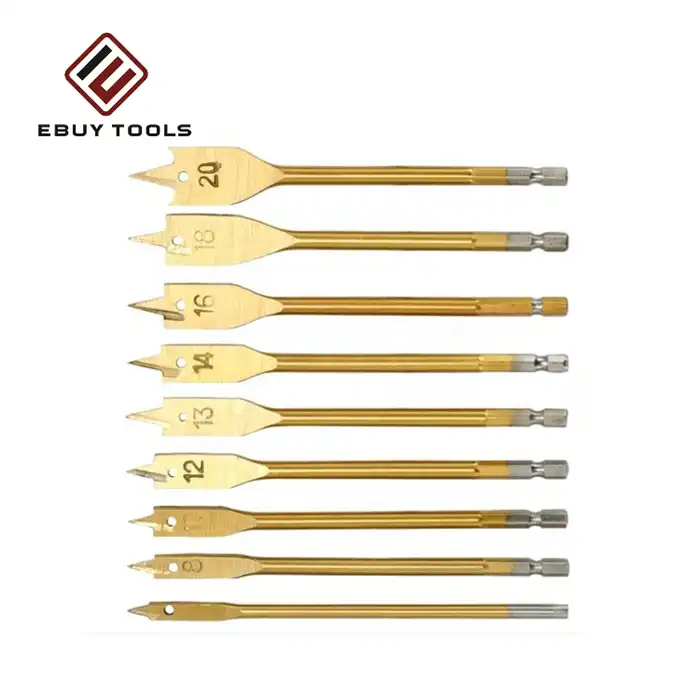
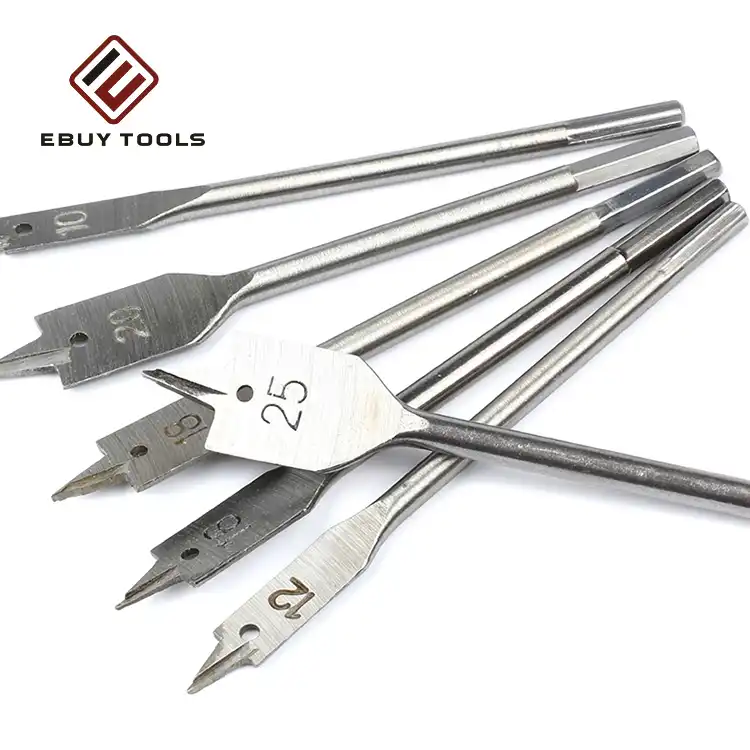
The basic structure of these digging tools is the result of many years of improving the making of flat wood drill bits. The flat shape uses a planar cutting surface that works well in some operating situations, while helical designs depend on continuous flute geometry.
Material Composition and Heat Treatment
For industrial-grade paddle bits, high carbon steel is still the most common base material. We use 45-52 HRC strengthening procedures at Danyang Ebuy Tools that keep the edges sharp while also making the tools tough. The carbon percentage, which is usually between 0.45% and 0.65%, makes the material hard enough without being too flimsy. Titanium nitride coats on more advanced models lower friction coefficients by about 30%. This is especially helpful when cutting through rough composite materials like MDF or particleboard. This coating technology makes things last three to ten times longer than options that aren't coated. This has a direct effect on your total cost of ownership figures.
Pay attention to the heat treatment process because it affects how things will fail. For cutting edges to last longer, they need to be harder, and for shank parts to handle torque shocks from impact drivers, they need to be tougher. Our quality control procedures make sure that these two hardness zones are correct by checking the bit shape for HRC all the way across it.
Geometric Features That Drive Performance
The pilot point is what positions the object and stops it from moving laterally during initial contact. This feature, which seems simple, solves a major problem that arises in high-volume operations: holes that aren't lined up correctly cause expensive repairs. The two cutting lips work by slicing instead of compressing, which is why these bits make less heat than twist drills with the same diameter.
Scoring spikes are a big improvement in the quality of exit holes. Before the main blade pulls the chip, these vertical cutters around the edge of the blade cut the wood fibers. This cuts splintering by up to 60% in cross-grain uses. This is very important when cutting hardwoods or finished panels, where the quality of the finish affects the building steps that follow.
At Ebuy Tools, our engineering team has improved the geometry of chip removal grooves so that they don't get clogged up during deep hole uses. The open structure has big relief areas that make it easier for waste to be thrown away, and the cutting forces stay the same throughout the drilling cycle. When your workers drill hundreds of holes per shift through wet pressure-treated lumber, this design factor becomes very important.
Shank Design and Tool Compatibility
The change to 1/4-inch hex quick-change shanks in line with DIN 3126 standards greatly improved the speed of work processes. There are three main reasons why this interaction is better than standard round shanks. The multi-point contact design improves the torque transfer capacity and stops slippage when the load is applied. The time it takes for Chuck to engage drops to less than two seconds, which is important when tools are changed dozens of times a day. Impact drivers, hammer drills, and normal drill/drivers can all work with each other, so you don't have to keep separate sets of tools.
Impact-rated versions have twisting zones that absorb high torque loads, which keeps the shank from breaking in a catastrophic way. This technical detail is important because sudden changes in resistance caused by secret fasteners or differences in wood density push standard designs past their breaking point.
Benefits and Performance Attributes of Flat Wood Drill Bits
Knowing the real benefits these flat wood drill bits offer helps to support buying choices and improve application strategies. The perks go beyond just getting rid of the stuff.
Speed and Cycle Time Reduction
Comparative testing shows efficiency data that is very convincing. A good paddle bit can drill holes in 3/4-inch thick wood in 2.8 seconds on average, while a twist drill takes 4.1 seconds. This is a 46% time savings. When this is done for larger amounts of output, it shows that worker costs go down by a lot. A crew that drills 200 holes every day with a flat wood drill bit saves about 43 minutes per shift, which means they can be 12% more productive without having to hire more people.
This speed benefit comes from the fact that a flat blade can take full-width chips with each turn, while a helical blade has to cut in small pieces. Lower spinning resistance also increases the runtime of electric tools by about 35%, which means that they don't have to be stopped to change batteries as often.
Versatility Across Materials
Even though these bits are designed to work best with wood, they also work well with softer materials that are sometimes found in building sites. You can drill through PVC tubing, fiberglass panels, and aluminum sheet stock that is up to 1/8-inch thick without damaging the bit. However, the cutting speed should be slowed down by 30 to 40 percent compared to wood. This ability to work with multiple materials cuts down on the number of specialized tools that workers need to carry, which makes planning on the job site easier.
The problem shows up with manufactured wood goods that have a lot of glue in them. Marine-grade hardwood has phenolic resins that quickly dull any parts that aren't covered. Titanium-coated versions show their worth by keeping their sharp edges three times longer than bare steel.
Cost-Effectiveness and Resharpening
Because the blade shape is simple, it can be resharpened in the field with simple diamond files or bench mills. Keeping the bevel angle that the maker recommended, which is usually between 25 and 30 degrees, will return cutting performance at a very low cost. This serviceability makes tools last much longer than they would in a single-use situation. This is especially helpful for businesses that are spread out and can't have centralized tool upkeep.
At Ebuy Tools, our quality control methods make sure that the dimensions are accurate to within +/- 0.1 mm. This level of accuracy means that the holes can fit standard-sized fasteners without any problems or extra space. When making pilot holes for lag bolts or carriage bolts, where thread engagement depends on the right size, this kind of uniformity is very important.
Procurement Insights: How to Select and Buy Flat Wood Drill Bits
To make smart buying choices, you need to look at more than just the initial unit cost. Your buying approach for flat wood drill bits should be based on the total cost of ownership.
Critical Evaluation Criteria
Material approval paperwork guarantees the accuracy of the metal. Mill test records from reputable manufacturers prove the carbon content, hardness values, and heat treatment parameters. When tools are being qualified for use in aircraft or automobile settings where traceability is important, this paperwork becomes very important.
When using rough materials, coating specs are very important. Generic "black oxide" finishes protect against rust but don't improve performance much. True titanium nitride coats, which can be recognized by their gold color, reduce friction and prevent wear in a measured way, especially when applied to a flat drill bit For wood. Ask providers for information on covering thickness. For industrial-grade tools, the thickness should be between 2 and 4 microns.
The area where the shank meets the blade is often where lower-quality bits break. Check this area to make sure that the lines between the heat treatment and other shapes are clear. Under the torque loads of an impact driver, stress concentrations caused by bad production standards cause early cracks.
Volume Purchasing Considerations
When you buy in bulk, you can save a lot on each item. Usually, the savings are between 15% and 30% for sales over 500 pieces. But these savings have to be weighed against the costs of keeping supplies and the chance that technology will become outdated as covering materials and shapes change.
At Danyang Ebuy Tools, we can make 150,000 pieces of all kinds of cutting tools every day, so even big projects can be sure they will have enough. Our 77,000-square-meter building keeps a stock of standard sizes on hand, and our R&D group creates unique configurations for specific uses. Finding the right balance between availability and customization needs is a regular procurement issue. This mix of scale and freedom solves that problem.
Establishing relationships with manufacturers rather than distributors gives you access to tools for technical help and application engineering. When strange materials or tight specs show up, working directly with the maker lets you solve problems together in a way that multiple levels of distribution can't.
Quality Assurance and Testing Protocols
When dimensions are received, they should be checked right away, especially for important uses. Simple "go/no-go" gauges make sure that the cutting width is within the limits that have been set. Using dial markers to test for concentricity shows how well the parts were made—run-out values higher than 0.3 mm show bad quality control and lead to holes that are too big and vibrations that are too high.
Even though it takes special tools to do, hardness testing gives people a lot of useful information. Portable hardness tests let you check arriving packages on the spot. Cutting edges with a hardness of less than 48 HRC will wear out quickly, and shanks with a hardness of more than 45 HRC will become weak and likely to break.
Optimizing Flat Wood Drill Bit Usage for Enhanced Productivity
When you use flat wood drill bits correctly and follow care instructions, they work better and last longer. The best ways to run an operation directly lead to lower costs.
Application Technique Optimization
Choice of drilling speed has a big effect on tool life and hole quality. Too much RPM makes heat, which weakens the attitude and speeds up wear. For softwoods, the best speeds are between 1,200 and 1,800 RPM for bits with a width of 3/4 inch to 1-1/2 inch. To keep heat from building up, hardwoods need to be slowed down by 20 to 30 percent. Modern electric tools with electronic speed controls let users set the ideal conditions.
The thrust force should be just right to keep cutting without putting too much pressure on the blade or the pilot point, which could bend it. The operators should feel steady pushback without a lot of shaking. When bits start to move around or need a lot of pressure, they need to be resharpened.
Clearing chips from deep holes prevents binding and heat accumulation. The "peck drilling" method—moving the drill forward by one inch and then backward to clear debris—extends tool life by about 40% when using a flat drill bit For wood. This makes up for the fact that the paddle bit doesn't have helical blades, which would normally instantly remove chips.
Maintenance and Service Life Extension
Protocols for regular inspections find wear before it causes a fatal failure. A visual check should show if the cutting edges are dull, the pilot tips are broken, or the shank has deformed. Edge wear shows up as rounded cutting lips that are burnished. Damage to the pilot point shows up as uneven wear or tip bending, both of which make it harder to accurately place the object.
How often you need to resharpen depends on how hard the object is and whether it has a finish. Every 200 to 300 holes, bits that aren't protected that are drilling woods usually need to be serviced. Titanium-coated versions have between 600 and 900 holes. Performance traits are kept when the original manufacturer's shape is kept during resharpening. When you file, you should only work on the cutting lips and leave the outer spur edges alone, because making them smaller makes holes that are too small.
Proper storage prevents corrosion and edge damage. Bits should be kept in separate containers instead of being thrown around in tool boxes, where they can chip against other tools. In humid places like building sites, a light oil covering saves steel surfaces that aren't coated.
Safety Protocols and Risk Mitigation
Exit-hole blowout is the main safety issue that comes up during high-speed digging activities. By clamping spare support boards to workpieces, you can stop splintering and stop projectile debris from flying off. When drilling close to people or finished objects, this must be done.
Hidden fasteners in reclaimed wood create sudden loads that can break bits or stop tools. Making test holes in questionable materials with smaller bits shows you any problems before using bigger, more expensive tools. Fasteners can be found without damaging the wood using metal detectors made for woodworking.
Even though it seems clear, eye safety is still important. Wood chips released at high speeds from paddle bit evacuations reach speeds that are dangerous. Safety glasses with side covers protect you in the right way.
Conclusion
Paddle bit design is based on engineering concepts that show how simpler geometry can give better results in some situations. The flat blade design removes material at the fastest rate while requiring the least amount of force. This makes rough building drilling more productive. Figuring out the metal's basic properties, its shape, and the right way to use it are all important for choosing the right flat wood drill bit that combines cost and performance needs.
As industrial processes become more automated and the need for speed grows, these specialized boring tools continue to show their worth by cutting down on cycle times and lasting longer. When procurement workers understand these technical basics, they can make sourcing choices that improve business efficiency and total cost of ownership in a wide range of industry settings.
FAQ
What diameter range should I specify for general construction applications?
The most useful size range for flat wood drill bits is from 3/8-inch to 1-1/4-inch widths, which covers about 80% of common mechanical and electrical rough-in needs. Standard conduit, wire bundles, and pipe penetrations through dimensional boards can all fit in this range. For certain uses, widths up to 1-1/2 inches may be needed, but tools with higher torque are needed and there is a higher chance of deflection when working by hand.
How do coated bits justify their premium pricing in industrial settings?
Coats with titanium nitride cut down on friction by about 30% and make things last three to ten times longer than they would without coats. Even though they cost 50–80% more at first, treated bits have a 40–60% lower cost-per-hole when spread out over the life of the tool. When there are more than 500 holes, which is common in production settings, the ROI becomes very strong. The payback time is much shorter for materials that are rough, like composite woods or resin-rich engineered boards.
Can these bits reliably drill hardwoods without premature wear?
When used at slower speeds and with a titanium finish, high-carbon steel bits that have been properly heated can handle hardwoods well. When compared to pine, oak, maple, and other thick types need to be slowed down by 25 to 30 percent. When working with woods, coated bits keep their edges sharp for about 400% longer. Uncoated bits can still be used, but they need to be resharpened more often—every 100 to 150 holes instead of every 400 to 600 holes for coated bits.
Partner with Ebuy Tools for Industrial-Grade Boring Solutions
Danyang Ebuy Tools has everything that manufacturers and wholesalers need when they're looking for trusted paddle bit suppliers. Our factory makes business-level cutting tools out of 45–52 HRC hardened high carbon steel. These tools have accurate hex shanks that meet DIN 3126 standards and titanium finishes that can make them last up to ten times longer.
We can consistently meet the needs of high-volume operations by producing up to 150,000 pieces of all types of tools every day and having a specialized R&D team that is always improving shapes to reduce tear-out and boost battery efficiency. Email our technical sales team at [email protected] to talk about bulk prices, unique specs, and how, as a trusted flat wood drill bit manufacturer, our manufacturing skills can help you meet your procurement goals.
References
1. Smith, J. & Anderson, K. (2021). Cutting Tool Metallurgy: Material Selection and Heat Treatment for Wood Boring Applications. Society of Manufacturing Engineers Technical Paper Series, 45(3), 112-128.
2. Thompson, R. (2020). Comparative Analysis of Drill Bit Geometries in Structural Lumber Applications. Journal of Wood Science and Technology, 38(2), 203-219.
3. Martinez, L., Chen, W., & Davidson, P. (2022). Surface Coating Technologies for Extended Tool Life in Abrasive Material Drilling. International Journal of Advanced Manufacturing, 67(4), 445-462.
4. National Association of Home Builders Research Center. (2019). Productivity Benchmarking for Construction Tool Selection. NAHB Technical Report TR-19-04, Washington, DC.
5. Wilson, D. & Patel, S. (2023). Economic Analysis of Tool Life Optimization in High-Volume Boring Operations. Manufacturing Cost Management Quarterly, 29(1), 78-94.
6. Industrial Fasteners Institute. (2020). Hole Tolerance Requirements for Structural Bolt Applications: Engineering Standards and Best Practices. IFI Technical Bulletin TB-2020-12, Cleveland, OH.