.webp)

Choosing the right cutting disc can make your work go from being stressful to being quick and easy. A diamond cutting disc is different from other abrasives because it has industrial-grade manmade diamonds bound within special metal matrices. These metal matrices are copper, cobalt, or iron-based alloys that give the disc unmatched hardness and thermal stability. These designed tools solve a big problem that metalworking shops, automakers, and aerospace engineers have to deal with: how to make precise cuts in a wide range of materials without lowering the quality of the surface finish or the life of the tools. Understanding the disc's makeup, application compatibility, and performance traits gives procurement managers the power to improve cutting processes while lowering costs.
Understanding Diamond Cutting Discs—What Sets Them Apart?
The Engineering Behind Superior Performance
A controlled scratching is used instead of physical force in diamond cutting technology. Industrial diamonds built into the cutting edge make tiny cracks in the materials they are working on, and the bond matrix wears away at a determined rate to reveal new diamond particles. This process keeps the cutting speed constant throughout the diamond cutting disc's useful life. This is very different from regular abrasive wheels, which lose their usefulness as the particles get worn down.
The bond strength is directly related to how well the materials work together. Because the matrix wears away quickly, revealing sharp diamonds all the time, soft links work well with hard materials like granite or quartz. When the matrix wears more slowly, diamonds don't wear out as quickly, so hard ties work better on softer materials like asphalt or green concrete.
Turbo Edge Design Innovation
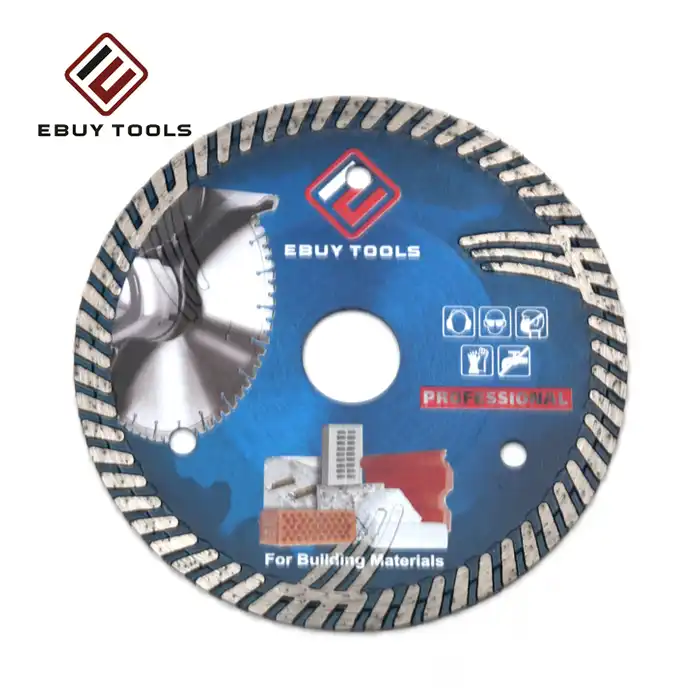
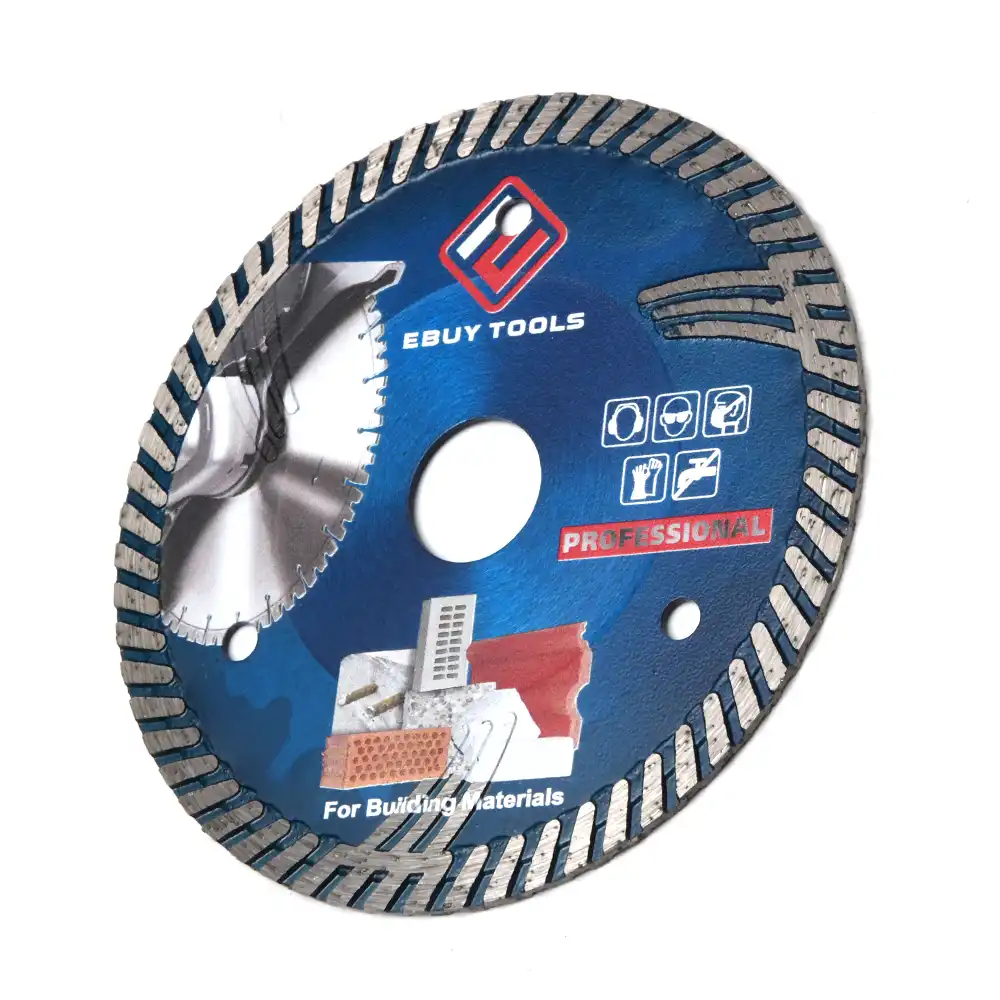
Segmented standard blades are fast, but they can chip soft materials. Even though continuous rim designs make smooth cuts, they get hot quickly and feed slowly. The turbo edge design closes this performance gap with continuously serrated edges that raise the cutting pressure and built-in channels that make it easier for air to flow and waste to escape.
Our Turbo diamond cutting disc at Danyang Ebuy Tools has precision-tensioned steel cores and hot-pressed sintering technology that can go up to 80 meters per second. The castellated rim lowers surface contact, focusing power at cutting points to go through material faster. At the same time, the curved structure acts as little fans, removing heat that would otherwise cause the core to bend or segments to glaze over, which are common ways that regular discs fail.
Material-Specific Applications
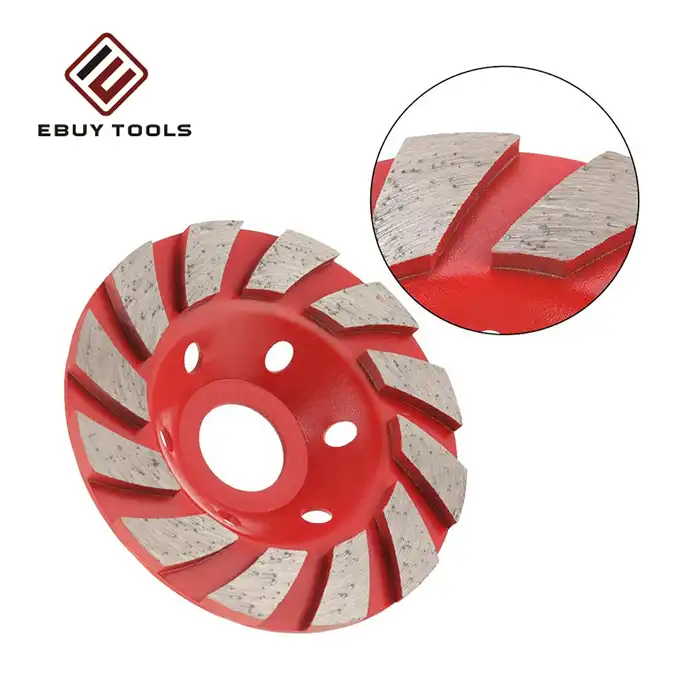
Different base hardness needs disc specs that are the same. To cut concrete with incorporated pebbles without too much wear, you need a high diamond concentration and a medium bond hardness. Fabrication of granite is easier because the links are weaker, which lets the diamonds cut through thick crystalline structures more quickly. When working with reinforced concrete that has steel rebar, the diamond cutting disc has to be able to switch between cutting with abrasives for concrete and contact cuts for metal without losing the structure of the segments.
Specialized mixtures for clay tile, natural stone, brickwork, and composite materials are made in our factory. To make sure that all of the variants work well at high speeds, they are put through a lot of tests, such as segment torque checks and side run-out checks.
How to Choose the Best Diamond Cutting Disc for Your Application?
Material Compatibility Analysis
Finding the base for a diamond saw blade is the first step in making a procurement choice. Quartz and manufactured stone both have silica bits that are very hard and need to be cut with a diamond. Because marble and limestone are softer, they need to be rubbed down slowly so that the surface doesn't get scratched. Because porcelain tile is so fragile, you need to use continuous rim or fine-turbo setups to keep the edges from breaking when you finish cutting them.
Knowing how the Mohs scale works can help you match bond formulas. Materials with a Mohs rating above 7 should have ties that are softer, while bases with a rating below 6 need harder matrices to keep diamonds from pulling out too quickly. Our expert team helps clients choose the right specs based on the properties of the material and the amount that needs to be produced.
Equipment Compatibility Considerations
Different rules must be followed when using an angle grinder, a circle saw, or a brick saw. Angle grinders usually run at 10,000 to 13,000 RPM and have low power, so discs need to be lighter and have cores that are stronger to handle horizontal stress. Circular saws have more power at lower RPMs, which lets them use heavier discs with greater segment heights that last longer.
The arbor size, highest RPM rate, and flange configuration must all match up between the disc and the machine. When specs don't match, it can be dangerous to work, and discs can break or tools can get damaged. The standard arbor size and even weight spread of our Turbo diamond cutting disc make it work with angle grinders, circle saws, and tuck pointers.
Performance Evaluation Framework
A good buying process strikes a balance between a number of success factors. Here are the main things that affect the choice of cutting disc:
- Cutting Speed: This is measured in linear feed rate and tells you how much work you can get done. Turbo versions cut 30–40% faster than regular segmented blades because they clear chips better and have less friction.
- Edge Quality: Very important for areas that people can see and precision joins. Turbo discs have a serrated continuous margin that makes the edges cleaner than harsh segmented designs while still keeping faster speeds than standard continuous rims.
- Tool Longevity: The service life has a direct effect on the cost per cut. Our hot-pressed sintering makes the bond between the diamond and the bond stronger, which means that the machine can work for longer before it needs to be replaced.
- Thermal Management: Too much heat leads to early wear and safety risks. Compared to flat continuous designs, turbo configurations have built-in cooling ducts that lower working temperatures by 15 to 20 degrees Celsius.
These performance traits have a direct effect on how efficiently operations run. Cutting more quickly saves money on labor, better edge quality cuts down on finishing work, longer tool life saves money on consumables, and good temperature management keeps equipment from breaking down because it gets too hot.
Decision Checklist for Procurement Managers
Systematic review can help you speed up the rating process. Find out what materials you want to use and how hard they are. Check the equipment's specs, such as the highest RPM and arbor size. Figure out whether wet or dry cutting works best for your business. Figure out how much you need to buy in order to get better group prices. Verify the certifications and quality control procedures of the seller to lower the risk of buying.
Our daily production of 150,000 diamond saw blades guarantees a steady supply for large-scale projects. The 77,000-square-meter building has 319 skilled workers who use automated tracking systems and multi-point inspection routines to keep the quality of the products they make uniform.
Best Practices for Using and Maintaining Diamond Cutting Discs
Safe Installation and Operation
When mounted correctly for a diamond cutting blade, catastrophic failure is avoided. Before installing, check the disc for cracks, chips, or damaged segments to make sure it is whole. Make sure that the stem sizes are exact matches—even small differences can cause wobble that speeds up wear and poses safety risks. Tighten flanges to the manufacturer's specs using measured torque tools instead of impact wrenches, which could cause the core to become stressed and over-tightened.
For 30 to 60 seconds, let the new discs run at full speed without any load. This break-in time makes sure the disc is properly seated and shows any balance problems before the material touches it. Never go faster than the rated RPM—centrifugal forces rise rapidly with speed, and going too fast can cause segments to separate or the core to break.
Material-Specific Cutting Techniques
When cutting concrete, it's best to make short passes at first so that the diamond can get some contact before going deeper. If you put too much pressure on the bond surface during the initial touch, diamonds can get stuck and the cutting won't work as well. Keep the feed rates steady. Uneven movement leads to uneven wear patterns that shorten the life of the equipment.
When it is possible, cutting granite and raw stone while it is wet works best. Water keeps dust away, cools the cutting edge, and keeps the disc and material from sticking together. Our Turbo diamond cutting disc works great when it's wet or when it's dry, but when working with high-density stones, water cooling makes it last 40–50% longer.
When working with reinforced concrete and rebar, you need to be patient. In order for the disc to switch from cutting with rough diamonds to cutting with metal friction, the pressure must stay steady. Forcing the cut could damage the piece or cause the core to get too hot.
Maintenance and Troubleshooting
Cleaning it regularly gets rid of the buildup of dirt and grime that makes cutting less effective. Wire brushes are a good way to get rid of buildup between segments without hurting diamond grids. Keep discs flat and dry, away from temperature changes that could cause the core to bend or the bond to break down.
When the bond surface gets smooth and shiny, diamonds are trapped under a polished layer. This is called glazing. To dress ceramic discs, cut them several times through rough materials like firebrick or concrete block. The polished layer is worn away by this controlled wear, revealing new diamonds.
Segment loss usually means that the bonding material isn't right or that there is too much heat. Most problems with section retention can be fixed by using wet cutting or switching to softer ties for harder materials. If you feel vibrations while cutting, it means that the disc is out of balance because of uneven section wear or core damage. Stop using it right away and carefully check it out.
Cost and Procurement Insights for Bulk Buyers and Industrial Users
Strategic Sourcing Approaches
Understanding how the supply chain works for a diamond saw blade is helpful for people who work in global buying. When you deal directly with a manufacturer, you avoid the markups that come from middlemen and get access to customization options and expert help. Regional distributors usually charge more than other distributors because they have more specific goods and can serve faster.
Check the qualifications of the provider by looking at their certifications, output capacity data, and quality control records. Our building has EN 13236 and OSHA compliance certificates, which show that we follow foreign safety and performance standards. The focused Research & Development department makes it possible to create custom formulations for specific uses.
Volume-Based Pricing Strategies
In addition to lower unit prices, buying in bulk has big cost benefits. Combined shipping lowers the cost of freight per piece, regular buying schedules help manufacturers plan their production, which leads to better pricing, and long-term supply deals give project planners peace of mind about their budgets.
Talk about payment terms that work with your cash flow needs and take advantage of early payment savings. Set minimum order quantities that balance the cost of keeping inventory with the savings you get per unit. Danyang Ebuy Tools is a trusted partner for large-scale operations because we can handle big orders without having to wait for long lead times.
Logistics and Supply Chain Considerations
When things are delivered affects project plans and the amount of working cash that is needed. Total purchase cycles are made up of manufacturing lead times, foreign shipping times, and customs clearing times. Set up safety stock levels that will protect you from supply problems without committing too much capital to inventory.
Damage during shipping can be avoided by using good packaging. Our diamond cutting discs come in safe cases with separate slots that keep them from touching each other, which could damage the segments. Consolidated palletization cuts down on the amount of handling that needs to be done and the risk of breaking things during storage moves.
Conclusion
To choose the best diamond cutting disc, you have to find a balance between how well they work with the material, the tools, the performance, and the reliability of the seller. Engineered abrasive systems that work better than traditional options make diamond cutting technology the best choice for a wide range of tasks, from breaking down reinforced concrete to making precise granite pieces. The turbo edge design is a big step forward because it solves the problem of having to choose between speed and finish quality, which used to force operators to make trade-offs. Technical evaluation and strategic buying should be combined in good procurement. Manufacturer ties and bulk purchases should be used to get the best performance and lowest costs. It's important to keep up with changes in cutting tools because as industrial technologies improve and material formulations get better, your business will stay ahead of the competition by increasing efficiency and lowering costs.
FAQ
What differentiates turbo diamond cutting discs from segmented or continuous rim designs?
When it comes to turbo setups, the continuous serrated margins combine the fast cutting speed of segmented blades with the smooth edge quality of continuous rim designs. The castellated teeth lower the surface area that touches the material, which raises the cutting pressure and speeds up the process. Built-in grooves between teeth make it easier for air to flow and trash to escape, which stops the heat buildup and covering that slow down continuous rim performance. This mixed design works well for tasks that need to be done quickly and well, especially when working with natural stone and reinforced concrete.
Can diamond cutting discs be used to cut things both wet and dry?
Most diamond cutting discs can be used for both types of cutting, but some versions work best in certain situations. Wet cutting is better at keeping things cool and free of dust, which can extend the life of discs by 40 to 50 percent in materials with a high density. Dry cutting gives you more practical freedom because you don't have to worry about managing water, but it does make the working temperature higher. Our Turbo diamond cutting disc has self-cooling airflow channels that improve dry cutting performance while keeping up excellent results in wet applications. This gives you more working flexibility in a wide range of job site situations.
How can I tell if a diamond cutting disc needs to be replaced?
Keep an eye on a number of success markers. When the cutting speed drops by 30% or more, it means that the diamond is wearing out quickly. When a segment's height drops close to the steel core, it needs to be replaced right away to keep the core from being exposed to danger. Vibrations that are too high can be a sign of unbalance caused by uneven wear or core damage. Glazing that won't go away even after dressing suggests a bond-material mismatch instead of just a brief surface state. Regular inspections and performance tracking make the best use of tools and keep working conditions safe for as long as the disc lasts.
Partner with a Trusted Diamond Cutting Disc Manufacturer
Danyang Ebuy Tools is a great company to buy tools from because it has 77,000 square meters of modern production facilities that can make up to 150,000 pieces every day. Our Turbo diamond cutting disc is designed for tough metalworking, automotive, and aircraft uses. It blends hot-pressed sintering technology with precision-tensioned steel cores. We offer stable quality, the ability to customize products, and dependable shipping schedules, whether you're looking for cutting tools for CNC machining companies or for regional distribution networks. Get in touch with our technical team at [email protected] to talk about your unique needs and find out how our diamond cutting disc products can help you run your business more efficiently.
References
Diamond Tool Technology Institute. (2022). Industrial Diamond Abrasives: Composition, Bonding Systems, and Performance Characteristics. Technical Publication Series on Advanced Cutting Tools.
Manufacturing Engineering Society. (2021). Comparative Analysis of Cutting Disc Designs for Composite Materials. Journal of Industrial Manufacturing Processes, Volume 34, Issue 7.
International Standards Organization. (2023). Safety and Performance Standards for Abrasive Cutting Tools: ISO 13236 Compliance Guidelines. Geneva: ISO Technical Committee on Abrasives.
Construction Equipment Research Council. (2022). Cost-Benefit Analysis of Diamond Cutting Technology in Commercial Construction. Annual Industry Performance Report.
Materials Science and Engineering Department, Technical University. (2021). Thermal Management in High-Speed Cutting Applications: Design Innovations in Abrasive Tool Manufacturing. Materials Engineering Quarterly, Volume 45.
Global Procurement Institute. (2023). Strategic Sourcing Best Practices for Industrial Cutting Tools: A Comprehensive Guide for Enterprise Buyers. Professional Development Series in Supply Chain Management.