.webp)

Step drill bits have revolutionized how metalworking professionals approach multi-diameter drilling operations, and nowhere is this more evident than with the HSS Step Drill Bit. This conical cutting tool, manufactured from high-speed steel with a distinctive staircase profile, allows operators to drill holes of multiple incrementally increasing diameters using a single bit. The design eliminates frequent tool changes, reduces setup time, and dramatically improves productivity in precision machining environments. When compared to traditional twist drills, the stepped geometry addresses critical pain points like workpiece "walking," material distortion in thin sheets, and the need for secondary deburring operations—making it an indispensable asset in modern fabrication workflows.
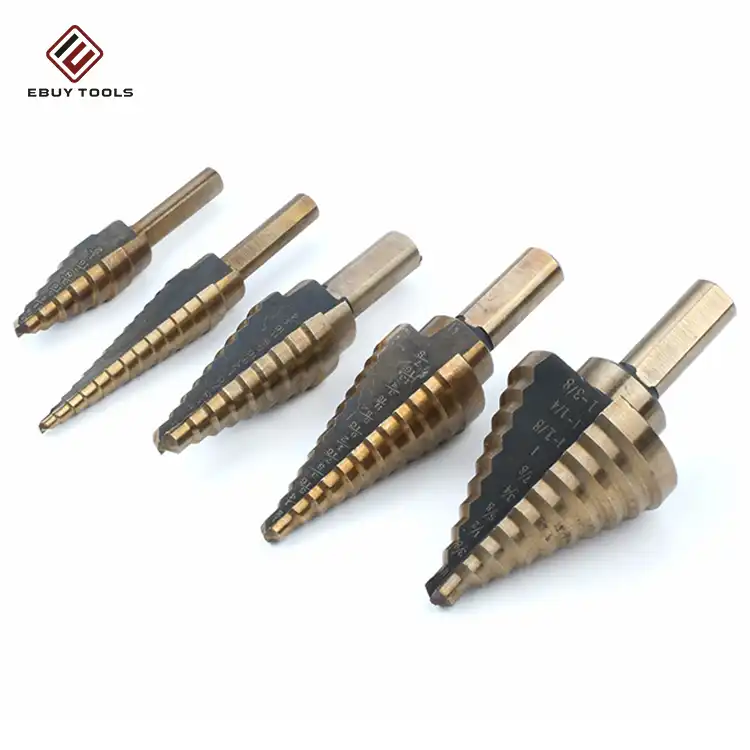
Understanding HSS Step Drill Bits and Their Unique Benefits
Step drill bits are a big step forward in metalworking tools because they solve problems that have been plaguing precision cutting for decades. Their unique design philosophy is what gives them the biggest edge.
What Makes HSS Material Superior for Step Drilling?
Due to its durability and heat resistance, high-speed steel is still the finest choice for step drill bits. Danyang Ebuy Tools uses 62–64 HRC HSS 4241 tool steel. This keeps cutting blades sharp even after long-term heating. The drill bit stays rigid when drilling hardened metals and stainless steel with this hardness. Its design allows it to withstand temperatures up to 600°C without losing its temper, which is crucial when working with frictional heat-generating materials. Advanced types, like M35 cobalt-alloyed steel, have "red hardness" and can cut at high temperatures that would soften regular steel tools.
Multi-Diameter Drilling in a Single Operation
The best part about step drill bits is that you can make holes of different sizes without switching tools. Our arrangement accommodates 4–32 mm hole diameters in 15 precise stages. Production managers say this feature lowers tool change time by 70% compared to twist drills while creating automotive parts. Each step chamfers the previous one and creates a neat, correct-sized hole. The bit stays centred during drilling because its conical shape guides it through larger diameters. This helps assembly lines, where thousands of parts must be uniform to improve quality and speed.
Burr-Free Results and Surface Finish Quality
In welding, burrs make it harder to put things together, put people in danger, and increase deburring time. Stepped form cutting solves this problem alone. Shearing creates a crisp edge that doesn't need polishing as each step enters the material. The triangular shank prevents it from slipping in the chuck, stabilising spinning and improving hole quality. Correctly used step drill bits always produce holes with surface roughness (Ra) less than 3.2 micrometres on 304 stainless steel sheets. This finish is suitable for most industrial uses without additional work. This cuts labour costs and cycle times.
Material Versatility Across Metal Types
Step drill bits can be used on an amazing number of different materials. Our HSS Step Drill Bits are specially designed to drill through steel, even tough grades of stainless steel, non-ferrous metals like aluminium and brass, and even engineered plastics. The spiral-shaped flute makes it easier for chips to escape smoothly when drilling in metal. This keeps chips from packing together, which can break the tool or make the material harder over time. Aerospace companies that work with titanium alloys say that drilling goes well when the right speeds and cutting fluids are used. The self-centering 118° split-point design keeps the bit from moving across the surface of the material. This is especially useful when working with thin-gauge metals, where precise hole placement is necessary to keep the structure together.
How to Use and Maintain HSS Step Drill Bits for Optimal Performance?
To make tools last longer and cut more accurately, you need to know the right way to use them and how to keep them in good shape.
Optimal Drilling Speeds for Different Materials
The most important operational variable affecting hole quality and tool longevity is speed selection. Step drill bits for mild steel should be used at 400–600 RPM. Stainless steel needs 250–400 RPM because overheating work-hardens it. Aluminium and other soft, non-ferrous metals can handle 1000 RPM. However, operators must monitor chip development to avoid thick edges. The goal is to balance cutting speed and feed pressure. Without enough feed pressure, the material is rubbed instead of cut, creating heat without removal. It produces spiral chips that cleanly exit the flutes when done correctly. Constant feed pressure works better than changing pressure, according to our IT staff.
Cutting Fluid Application and Thermal Management
Heat management extends tool life and improves hole appearance. Some materials can be machined without cutting fluid, but most are better with it. General steel drilling benefits from water-soluble coolants that cool and lubricate. Sulfur-based cutting fluids reduce friction and galling, which makes cutting stainless steel easier. Flood cooling—directing fluid flow at the cut to remove heat and chips—is recommended when possible. Squeezing a little oil every so often keeps the tool's temperature safe when flood cooling isn't available. Even when drilling without water, our superior bits produce less heat because their TiN layer lowers the friction coefficient to less than 0.4.
Identifying Wear Patterns and Replacement Timing
Workers can replace worn parts before they break badly by understanding wear. Focus on the cut edges at each stage. A modest rounding of the sharp edge indicates normal wear. The first cutting steps are usually smaller diameter. Too much wear causes chipping, edge sharpness loss, higher drilling pressure, and poor hole quality. The separation point should remain sharp and uniform. The bit must be replaced or resharpened if it flattens or becomes uneven. Operators often notice performance deteriorating due to shaking or rattling. Our quality control tests show that mild steel drill bits should drill 200–300 holes before needing repair. This varies greatly based on material strength and operating conditions.
Storage and Handling Best Practices
Keep your precise tools organised to protect your investment. Every HSS Step Drill Bit should have its own case or organiser to prevent cutting blades from touching other tools. Our bits' triangular shanks reduce rolling, but they may still be stored safely. To prevent corrosion, clean bits well after use to remove metal chips and cutting fluid. A small layer of tool oil prevents metal corrosion during storage. Keep parts away from extreme weather and humidity. For transporting bits to job sites, foam cases with individual bit supports work well. These easy actions prevent edge damage, which affects cutting quality and lengthens repair times.
Comparing HSS Step Drill Bits to Alternative Drill Bit Types
To choose the right cutting tool, you need to know how different types of materials and styles work in different situations.
HSS Versus Cobalt-Alloyed Variants
Most mild steel, aluminium, and brass metalworking tasks work well with high-speed steel step drill bits. Due to better heat protection, cobalt-alloyed versions, especially M35 with 5% cobalt, are better for cutting hardened steels or long production runs. Cobalt helps steel maintain its hardness at high temperatures, preventing softening during protracted drilling operations. Even though they cost more, cobalt bits last longer and save money on per-hole costs in continuous production settings. Cobalt bits break more easily if subjected to excessive lateral tension or feed pressure. We found that M35 cobalt step drill bits last three to five times longer than HSS bits when drilling 316 stainless steel sheets.
Coated Versus Uncoated Tool Performance
Surface coats advance cutting tool science. The gold-colored Titanium Nitride (TiN) coating makes the surface tougher to over 2500 Vickers and reduces tool-workpiece friction. This blend lowers heat and abrasive wear, which is useful when drilling hardening materials. Titanium Aluminium Nitride (TiAlN), a more advanced covering, does better at 800°C and above. Work is where speed differences are most noticeable. Our automotive part manufacturers say TiN-coated bits drill 4–6 times more holes before needing replacement. The coating also prevents materials from sticking, reducing the built-up edge effect and hole quality. Coated bits cost more, but their longer life and higher productivity make them worth it in middle to high-volume uses.
Step Bits Versus Traditional Twist Drills
Key benefit of step drill bits is speed and ease of use. Twist drills require a variety of bits, frequent tool changes, and accuracy issues when enlarging holes. Each tool change slows production, causes placement errors, and wastes time. Step drill bits eliminate waste by merging many operations into one tool run. The stepwise process saves time and improves sheet metal performance. Traditional twist drills catch and bend thin materials as they break through, creating triangular or torn holes. The step bits' progressive diameter increase prevents breakthrough distortion and creates round, clean holes. Step bits can only work with materials up to 6 mm thick, but twist drills can handle deeper materials.
Procurement Insights: Where and How to Buy Quality HSS Step Drill Bits?
Strategic choices about where to get cutting tools have a direct effect on how well they work and how much they cost to own.
Evaluating Manufacturer Capabilities and Certifications
When choosing an HSS Step Drill Bit provider, the size of the factory and the quality control methods are two of the most important ways to tell how reliable they are. At Danyang Ebuy Tools Co., Ltd., our 77,000-square-meter building and 319 trained workers provide the tools we need to consistently produce high-quality work. Our cutting tool range can make more than 150,000 pieces every day, so even for big sales, the supply will stay stable. Quality certifications show that a company is committed to meeting manufacturing standards. Look for suppliers who have documented quality control systems that include procedures for checking chemical analyses, testing hardness, and checking dimensions. Our Research and Development (R&D) team is always making our ideas better and can come up with custom solutions for unique uses. Professional-grade manufacturers are different from commodity suppliers because they can give technical details like hardness ratings (our bits have 63–67 HRC), coating properties, and dimensional tolerances. Supply chain risk is lower when these skills are checked through site checks or third-party certifications.
Bulk Purchasing Considerations and Value Assessment
When you buy in bulk, you have to balance the unit cost against the total value provided. Even though the price per piece goes down as the number of pieces ordered goes up, procurement managers should still look at a number of other factors. The life of a tool has a direct effect on operational costs. A bit that costs 20% more but lasts twice as long is a better deal. Manufacturers put a lot of faith in the quality of their products, and warranties give customers a way to get their money back if tools break too soon. Consistency in lead times is important for planning production. Suppliers with larger inventories and set production schedules lower the risk of running out of stock, which can stop operations. The smallest amount you can order should be in line with how much you normally use and how much it costs to keep supplies on hand. We work with distributors and direct customers to set up orders in a way that maximises volume and makes inventory management easy. Having access to application engineers who can suggest the best speeds, feeds, and tool selection for different materials saves a lot of time and money compared to trying things out and seeing what works and what doesn't.
Global Logistics and Supply Chain Management
When you buy cutting tools from other countries, you have to think about logistics, which can change the total cost and the stability of the supply. Knowing the wait times from placing an order to arrival lets you plan production accurately. Ocean freight is cheaper for large shipments, but it takes longer to deliver. Air freight, on the other hand, speeds up delivery at a higher cost. Our Danyang City office focuses on exports, so we have established shipping ties and knowledge of paperwork that makes foreign transactions easier. Good packaging keeps precision tools safe while they're being shipped. Our protective packaging makes sure that bits arrive in perfect condition, without any edge damage that would affect their performance. When B2B buyers are setting up long-term ties with suppliers, they might want to look into consignment inventory deals or scheduled shipment programs. These can help them save money on inventory costs while still making sure they have access to materials. Total costs are also calculated by taking into account things like currency exchange rates and payment terms. Shipping problems can cause delays and extra costs, so it's best to work with providers who know how to handle foreign trade and provide the right paperwork for customs clearance.
Real-World Applications and Case Studies: Maximizing ROI with HSS Step Drill Bits
Practical examples demonstrate how step drill bits solve specific metalworking challenges across diverse industries.
Automotive Component Manufacturing Efficiency Gains
A tier-two car source that made gearbox housings had trouble getting their drilling work done quickly. As part of the production process, test holes had to be made, then enlarged to the final diameter, and the edges had to be chamfered. These are three separate steps that needed to be done with different tools. When they switched to our HSS Step Drill Bits, these tasks were combined into a single pass. The change cut the cycle time for each part from 47 seconds to 18 seconds, which is a 62% improvement. The number of tool changes dropped by a huge amount, which almost completely eliminated the placement mistakes that sometimes led to scrap parts. Because the bits could keep their tight standards, no adjustments had to be made to the assembly steps that followed. The time saved on labour alone more than paid for the new tools eight times over during a production run of 50,000 units. Also, the burr-free holes got rid of the need for a hand deburring station, which freed up two workers to do more important work.
Precision Sheet Metal Fabrication Quality Improvements
A company that makes electrical enclosures had trouble with the quality of the holes in stainless steel junction boxes. Standard twist drills made holes that were not round and had big burrs in them. The breakthrough action also often dented the back of the enclosure. These flaws made it hard to put together cable glands and made it harder to make the waterproof seals that are needed for outdoor installations. The quality of the holes got better right away after we switched to our spiral flute step drill bits with TiN finish. The stepped cutting action got rid of breakthrough distortion, leaving holes that were ideally round and with straight sides. The dependability of the gasket sealing improved, which cut down on guarantee claims related to water getting in. The maker also found a benefit they didn't expect: the ability to work with multiple diameters let them make mounting holes for cable glands of different sizes without having to switch tools, which increased the freedom of their production. The time it took for quality control inspections went down because fewer holes needed to be fixed or thrown out.
Aerospace Machining of Titanium and High-Strength Alloys
Machining aerospace parts puts a lot of stress on the cutting tools used. A company that makes structural parts out of titanium needed to make holes in airframe parts to let light pass through. Titanium is very strong, but it doesn't conduct heat well, so the cutting edge gets very hot very quickly, shortening the life of the tool. We got good tool life in this tough job by using our HSS Step Drill Bit with M35 cobalt-alloyed step drill bits with a TiAlN finish, cutting at the right speed (below 300 RPM), and cutting oil that is based on sulphur. The self-centering shape was especially useful because the setting accuracy had to be within 0.05 mm—expensive workpieces would have been thrown away if the tool had moved during the initial penetration. The bits' ability to stay centred across the entire diameter range made sure that the holes met the strict tolerances needed for aircraft uses. The cost of the tool per unit was higher than for normal tasks, but the savings in scrap and rework made it worth it.
Conclusion
Step drill bits are a revolutionary new tool for dealing with metal that has made it easier to get things done faster, better, and cheaper. In addition to saving time, this method also lowers the number of tools that need to be kept on hand, improves hole quality, gets rid of unnecessary steps, and makes workers safer by reducing the amount of time they spend handling sharp burrs. When cobalt alloying and advanced coatings are added to high-speed steel building, it makes the steel last longer in harsh production settings in the automobile, aerospace, electrical, and general fabrication sectors. When making strategic purchasing choices, putting maker capability, product quality, and total cost of ownership at the top of the list is better in the long run than just focusing on unit price. As metalworking shops continue to be pushed to be more productive and consistent with their quality, step drill bits offer tried-and-true solutions backed by data on how well they work in a wide range of situations.
FAQ
What drill speed should I use for stainless steel?
Because it work-hardens more slowly, stainless steel needs much slower speeds than mild steel. When drilling stainless steel, we suggest that you use our step drill bits at speeds between 250 and 400 RPM. When you combine these slower speeds with steady feed pressure and the right cutting fluid, you can keep the work from hardening and make the tools last longer. Higher speeds make too much heat, which softens the cutting edge and breaks the tool before it should.
Can step drill bits be resharpened?
It is scientifically possible to sharpen step drill bits again by grinding the flute sides, but without special tools, it is hard to keep the original shape. Once the cutting performance starts to drop, most production facilities throw these away. Because of the complicated stepped geometry and need for exact angles, manual sharpening is not a good way to keep up with original performance standards. Replacing old parts usually gives more reliable results than trying to fix them.
Why do my bits break when drilling thin sheet metal?
When working with thin materials, bit breakage is usually caused by going too fast and not having enough support under the workpiece. The breakthrough point puts force on the bit from the side, which can break it if the material bends. Putting a backing board under the sheet gives it support and stops it from bowing. Lowering the feed pressure as the bit gets closer to breaking through also helps keep it from catching, which can cause the tool to break.
Partner With Ebuy Tools for Your HSS Step Drill Bit Requirements
Danyang Ebuy Tools Co., Ltd. is ready to help you with your metalworking projects by making cutting tools that are precisely engineered and made to your exact specifications. The performance features that precision machining shops, automakers, and aerospace component makers need are all available in our HSS Step Drill Bit. Our 77,000-square-meter factory makes more than 150,000 items every day, so we can guarantee a steady flow of goods so that work can continue as usual. Our dedicated R&D team and strict quality control systems make sure that every piece meets the requirements for coating, hardness, and concentricity in your applications. As a well-known HSS Step Drill Bit manufacturer with a lot of export experience, we know how hard it can be for B2B buyers to find the right products. That's why we've built our services to provide value beyond just product supply. Email our team at [email protected] to talk about your particular needs, get technical specs, or set up a sample review. We're dedicated to forming long-lasting relationships that help you run your business successfully.
References
1. Machinery's Handbook, 31st Edition. Industrial Press, 2020. Section on Twist Drills and Cutting Tools.
2. Astakhov, Viktor P. "Tribology of Metal Cutting." Journal of Manufacturing Science and Engineering, Vol. 142, 2019, pp. 1-18.
3. Society of Manufacturing Engineers. "Cutting Tool Applications: Step Drill Design and Application." SME Technical Paper Series, 2021.
4. DeGarmo, E. Paul, et al. Materials and Processes in Manufacturing, 12th Edition. Wiley Publishing, 2018.
5. American National Standards Institute. "ANSI B94.11M-1993: Twist Drills - Nomenclature and Specifications." ANSI Standards Committee, 1993.
6. Shaw, Milton C. Metal Cutting Principles, 3rd Edition. Oxford University Press, 2020. Chapter 12: Drilling and Related Operations.