.webp)

One of the biggest safety and performance problems that precise machining shops, automakers, and aircraft engineering facilities have to deal with today is segment loss in diamond cup wheels. When grinding segments come loose during operation, they cause more problems than just instant safety risks. They also cause expensive production delays, damage expensive workpieces, and make it harder to trust your provider.
When procurement managers and workshop leaders know how quality manufacturing features stop segment separation, they can make decisions that protect workers and the bottom line. High-quality wheels use advanced bonding technologies, precise engineering standards, and strict testing methods to make sure that the segments stay safely connected even when grinding hard materials like concrete, granite, marble, and more.
Understanding Segment Loss in Diamond Cup Wheels
What Causes Segments to Detach
When operating stress breaks the mechanical bond between the diamond-impregnated segments and the steel body, the segments come loose. The main cause is bad manufacturing, especially when welding doesn't go deep enough during section connection. When high-frequency welding or laser welding doesn't go deep enough, pieces don't have enough structural stability to handle centrifugal forces at speeds higher than 10,000 RPM. Weak spots can be caused by temperature cycle stress when the steel core and bond matrix are not made of the same material.
Bad application speeds up segment failure. When you run grinding wheels faster than their stated speed, they create too much rotating force that can break even the strongest joints. When grinding, putting horizontal pressure on the segments instead of keeping them flat causes stress to build up at the ends, which weakens the attachment surface over time. When you switch between wet and dry grinding without giving them enough time to cool down, you cause thermal shock. This makes the steel bodies and diamond pieces expand at different rates, which causes tiny cracks that spread with continued use.
The Real Cost of Segment Failure
Losing a section has a financial effect that goes beyond the cost of replacing. Unplanned downtime in the making of car parts can stop whole production lines. When you add up the hourly losses for labor, costs, and contractual fines for late deliveries, you can reach thousands of dollars. Even worse things can happen in aerospace machining processes. If a section comes loose and damages a titanium alloy part, parts worth tens of thousands of dollars may have to be thrown away.
Accidents that happen at work cost both money and lives. When pieces come loose, they turn into high-speed weapons that can hurt people seriously, even if they are wearing the right safety gear. Workers' compensation claims, regulatory reviews, and possible plant shutdowns are just a few of the problems that can happen when you buy cheap diamond cup wheels. When goods that distributors and tooling wholesalers sell fail horribly, it hurts their image and puts at risk long-term client relationships based on trust and dependability.
Core Safety Features That Prevent Segment Loss
Advanced Bonding Technologies
Professional diamond cup wheels use a number of different gluing methods, each of which is designed to give the wheel a certain set of performance qualities. High-frequency welding joins steel pieces at the molecular level, making the shear strength higher than 150 Newton-meters in normal torque tests. In this process, the contact is heated to exact temperatures that allow metallurgical bonding to happen without damaging either the diamond cup wheel's diamond matrix or the qualities of the heat-treated steel body.
Laser welding is very accurate and can be used in situations where exact section positioning and few heat-affected zones are needed. The focused energy beam makes narrow, deep welds that go through the bases of segments without heating up the areas around them. This technology works especially well for turbo rim designs where the section shape needs to stay at exact angles for the best waste evacuation and material removal rates.
Using cold pressing to join pieces together uses mechanical fitting that is helped by special adhesives that can work continuously at high temperatures. This method isn't used very often in heavy-duty situations, but it can be useful in some cases where the heat from the welder could change the carefully controlled diamond concentration variations within segments. Manufacturers like Danyang Ebuy Tools carefully mix these technologies, choosing fastening methods based on the job and the required hardness of the material.
Segment Design Engineering
Segment design has a direct effect on how long a structure lasts and how well it handles operating stress. Height-to-width ratios affect the leverage forces that are used during grinding. For example, longer segments have higher bending moments that put stress on the connection points, while designs that are the right proportions spread forces more widely across the bonding interface. Spreading segments evenly around the wheel's diameter makes sure that the load is evenly distributed during spinning. This stops the harmonic vibrations that weaken joints over time.
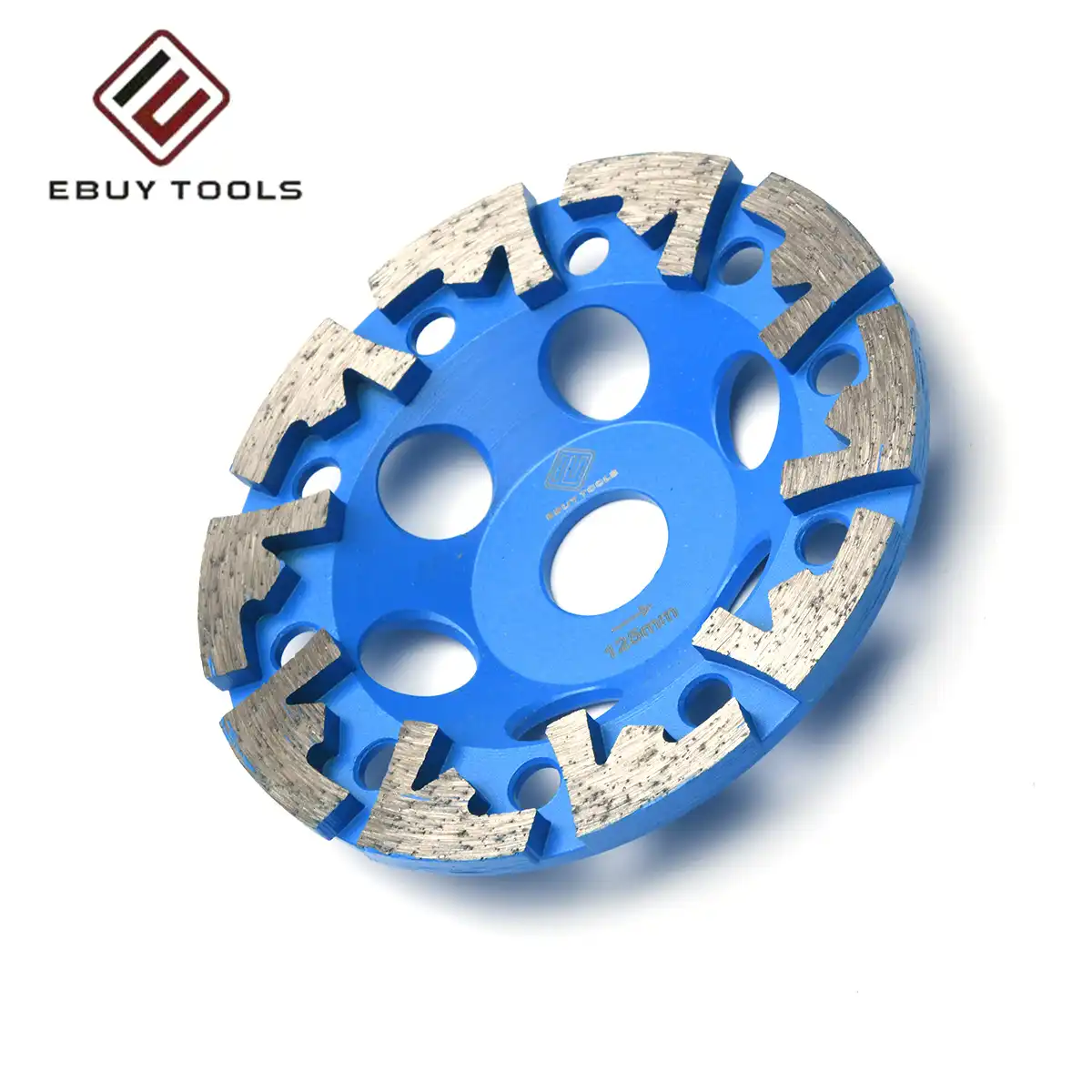
Turbo rim styles have ventilation holes that are placed in a way that serves two purposes. These features keep air moving, which cools things down and gets rid of frictional heat, which lowers the stress on segment links. At the same time, the aerodynamic shape makes it easy for trash to be swept away quickly, which stops material buildup that could lead to uneven pressure conditions. The split turbo rim design removes material quickly while maintaining structural integrity. This makes it perfect for heavy-duty jobs like preparing concrete surfaces and making stones.
Steel bodies that have been heated up provide the base for safe section attachment. Treatment methods raise the core's hardness to certain Rockwell C levels that keep it from deforming under practical loads while still letting it bend enough to take impacts without breaking into weak pieces. This well-balanced metallurgy makes sure that the base material can hold up welded parts for the life of the wheel, even in tough situations like those found in construction engineering.
Precision Balancing Standards
Dynamic balance testing makes sure that wheels don't move in a way that speeds up section wear and puts stress on connection points. Manufacturers who make good products get balance marks of G6.3 or higher, which are found by rotating the parts quickly and looking for small problems with how the mass is distributed. Wheels that meet these requirements have very little shaking while they're in use, which keeps the user from getting tired and protects the angle grinder spindle bearings from wearing out too quickly.
Run-out tolerances control how far an axis or a rotational part deviates from its true spin. Professional-grade wheels keep their margins below 0.1 mm, which makes sure that the whole section surface is ground in the same way, and this precision is especially critical when using a diamond cup wheel, because any imbalance would directly compromise its aggressive cutting face. This accuracy stops the bouncing action that puts a lot of stress on certain parts, so wear is spread out evenly and the tool's performance stays stable over its lifetime. Ebuy Tools does full measurement accuracy checks by measuring the sizes of arbor holes to make sure that standard equipment setups can be mounted securely and without vibration.
Best Practices for Using Diamond Cup Wheels to Minimize Segment Loss
Proper Mounting and Compatibility
The first step in a proper installation is to make sure that the wheel's specs and the grinder's powers are compatible. The important safety buffer is to match the wheel's highest rated RPM to the tool's no-load speed. Running tools at speeds higher than the wheel's ratings greatly increases the centrifugal forces on segments. Complete thread contact and the right amount of torque are needed for threaded hub connections. If the torque isn't applied correctly, the threads can move and damage the mounting surfaces, and if the force is too high, the steel body can crack.
Operational safety is directly affected by the state of the flange. When flanges are damaged or worn, they create uneven clamping pressure that causes wobbling and puts stress on specific parts. Cleaning the fastening surfaces of any dirt or dust will make sure that the whole contact area engages, spreading the clamping forces evenly. Operators should regularly check the backup hubs and replace any parts that show signs of wear, damage, or contamination that makes it harder to keep the diamond cup wheels in place.
Material-Specific Application Guidelines
Choosing the right grit sizes for different surfaces improves performance and keeps section integrity safe. For aggressive stock removal on high-PSI concrete and natural stone, coarse grits from 16 to 30 mesh work best. This is because bigger diamonds can handle the impact forces that come up during quick material removal. Medium grits, which are between 40 and 80 mesh, work well for general grinding on marble, tile, and moderately hard concrete. Fine grits between 120 and 150 mesh give granite and manufactured stone smooth edges without putting too much cutting pressure on the segments.
The "opposite rule" idea is used to choose the bond strength that gives the best diamond exposure rates. Hard materials like finished concrete and granite work well with soft ties because they wear away at controlled rates that keep revealing new cutting edges. When it comes to asphalt and green concrete, which are softer or more rough, hard ties work best because they don't wear down quickly, which would waste expensive diamond content. If the bonding materials don't match, they either glaze over, hiding diamonds under worn matrix material, or they wear out too quickly, cutting down on tool life and increasing the risk of premature segment failure.
Because good wheels have air holes, they can be used for both wet and dry grinding. For thermal management, dry grinding creates a lot of contact heat that needs to be let out properly. Wet grinding, on the other hand, keeps the segments cool all the time, which increases their life. Changing between methods during the same session causes thermal shock. Using the same cooling methods throughout activities stops the stress cycle that breaks down segment bonds.
Maintenance and Inspection Protocols
Visual checks done on a regular basis find early warning signs of failure before they become catastrophic. By checking segments for cracks, chips, or signs of bond line separation, wheels can be retired on time, which stops dangerous removal events before they happen. Measuring the height of the section in several places shows uneven wear patterns that point to operating problems like misaligned mounting, bent spindles, or bad grinding technique that need to be fixed to stop the damage from getting worse faster.
Diamond cup grinding wheel cleaning protocols must be selected with particular care, because how wheels are cleaned has a big effect on how long they last and how consistently they work. Getting rid of stored trash stops material growth that causes uneven loading and blocks the flow of cool air through ventilation systems.
Different types of contamination need different cleaning methods. For example, wire brushing is a good way to get rid of concrete waste, while solvent cleaning is good for getting rid of glue and coating buildup. Structural integrity is kept by avoiding intense mechanical cleaning that could damage section edges or weaken bond surfaces.
Wheel ready and dependability are affected by how they are stored. Keeping tools in dry places stops the steel bodies from rusting, which could weaken the structure and make it harder for segments to connect to each other. When you store wheels flat or properly supported, they don't bend or warp because of gravity, which could change how balanced they are. Keeping the wheels from getting damaged by impacts while they are being stored and moved helps keep the precise engineering that makes sure they work safely and well.
Comparing Quality Diamond Cup Wheels: Safety Features Across Top Brands
Manufacturing Standards and Certifications
Leading makers follow strict international safety rules that guide how superabrasive tools are made and how well they work. Compliance with EN 13236 makes sure that wheels meet European safety standards for the fastest speeds they can go, their ability to fight bursts, and their overall strength. ISO 6104 approval verifies the accuracy of measurements and the regularity of production, which are important for making sure that all production batches work well. When procurement managers look at suppliers and decide who to buy from, these licenses give them concrete quality standards to use.
Processes for quality control set skilled makers apart from suppliers of goods. Destructive shear testing, which is part of comprehensive testing methods, proves that the welding is strong and that the segment attachment can withstand forces greater than normal loads. Testing the rate of material removal on standard concrete grades confirms the performance specs, making sure the wheels deliver the output they promise. Danyang Ebuy Tools uses strict inspection methods that include checking the dynamic balance, measuring the dimensional error, and checking the abrasion performance. These are backed up by advanced testing tools in our 77,000-square-meter building.
Diamond Concentration and Matrix Metallurgy
The quantity of diamonds has a direct effect on both how well it cuts and how the segments are built. As more cutting edges contact the object at the same time, a higher diamond density speeds up the removal of material and extends the life of the tool. The concentration must strike a balance between how well it cuts and how strong the matrix is. Too much diamond content can weaken the metallic bond material, and not enough concentration makes each diamond take on more stress, which speeds up wear on diamond cup wheels.
Matrix metallurgy tells us how well the bond material holds diamonds in place while wearing at the right rate for ongoing edge exposure. Cobalt-based grids are better at resisting wear and are therefore ideal for harsh grinding tasks on hard materials. Copper-based mixtures are very good at moving heat, which gets rid of contact heat and keeps diamonds and segment links from getting damaged by heat. For general-purpose uses, iron-based grids provide good efficiency at a low cost. The best makers make sure that the matrix makeup is just right for each application by matching the metallurgical properties to the conditions that will be used for grinding.
Customization Capabilities and Technical Support
Having access to customized solutions meets the needs of specific applications that standard goods can't fully meet. Manufacturers who do their own research and development work with customers to come up with custom section shapes, bond formulations, and dimensional configurations that work best with certain materials, tools, and performance goals.
This partnership method is very helpful for aircraft machining that needs to work with rare alloys or mold and die makers that need very precise surface finish qualities. Diamond cup grinding wheel options, for example, can be tailored within these custom formulations to optimize material removal rates and thermal stability, further extending the benefits of bespoke design to high‑precision grinding tasks.
Transactional sellers are different from suppliers who care about their clients' long-term success because they don't offer technical support services. Application engineers with a lot of experience help with choosing wheels, setting up operations, and fixing problems so that tools work better and practical problems are kept to a minimum. Branding services that let distributors use custom packages and logos help them build a position in the market, and flexible minimum order amounts work for all types of businesses, from small regional suppliers to large contract makers.
Troubleshooting and Maintenance: Extending Diamond Cup Wheel Lifespan
Recognizing Early Warning Signs
Unusual noises during operation are a sign of problems that need to be fixed right away. High-frequency chatter means that segments are broken or there are problems with the spindle, while low-frequency noises mean that the wheel is out of balance because of uneven segment wear or mounting problems. Taking care of these symptoms right away stops them from getting worse and leading to segment separation. The vibrations make bond surfaces wear out faster, starting a circle of failure that ends in catastrophic failure if not stopped.
Uneven grinding patterns are a sign of problems with the way the machine works that could affect safety and performance. Surface finishes that are streaky or irregular show that different parts are wearing unevenly, which is usually caused by wheels that aren't balanced or grinding angles that aren't right. Glazed pieces that don't cut well anymore are a sign of bond hardness mismatches that need to be fixed by replacing the diamond cup wheels with those that meet the right standards. Visible segment cracks, especially those that start at bond lines, require the wheel to be retired right away, no matter how high the segment is that is still there.
Lifecycle Management Strategies
Tracking wheel performance measures lets you make replacement choices based on data, which makes the best use of tools without putting safety at risk. By keeping track of how much material is removed from the wheel over its useful life, performance degradation trends can be found that show when the wheel is getting close to the end of its useful life. Monitoring vibration levels at the site through baseline measures gives concrete criteria for retirement choices that go beyond what the operator thinks.
Total value extraction is maximized by rotating wheels through different uses based on how worn they are. When used in difficult aerospace applications, wheels that show some wear may still work very well when used in less important general manufacturing jobs. This tiered usage method gets the most work out of the tools that are bought while still leaving enough safety margins for the amount of application criticality.
Conclusion
To keep segment loss from happening, it's important to pay close attention to factory quality, correct application methods, and proactive repair schedules. For a diamond cup wheel, this means that every parameter—from bond hardness to operational speed—must be meticulously aligned with the manufacturer's guidelines to prevent segment detachment.
High-quality diamond cup wheels use advanced bonding technologies, precise engineering, and thorough testing to make sure they work well in a wide range of challenging industrial settings. Knowing about these safety features gives procurement professionals the power to make smart buying choices that protect worker safety and business efficiency. Using the right mounting methods, application rules for each material, and regular checking processes will make your tools last longer and reduce the chances of failures that stop production and put you at risk of being sued.
FAQ
How can I tell if a diamond cup wheel is properly balanced before use?
On the package or paperwork for professional wheels, the balance grade should be written down. Visual inspection shows clear problems—segments should be evenly spread around the edge, with no holes or unevenness that can be seen. By mounting the wheel and running the grinder for a short time at a low speed, you can find out if there is too much shaking, which could mean that the balance is off. Wheels from good sources are balanced to G6.3 norms or higher, which reduces segment stress caused by vibrations on the diamond cup wheel.
What should I do if segments start showing cracks during operation?
Stop using the wheel right away and get a new one. If you keep using cracked pieces, they could suddenly come off, which would be very dangerous. Look at the conditions of use that might have caused the cracking, like too much speed, wrong grinding angles, or not enough cooling, and fix them before putting on the new wheels. Write down the failure so that the seller can give you feedback, especially if more than one wheel from the same batch has the same problem.
Can I repair or re-weld loose segments on diamond grinding wheels?
Not at all. Repairs done in the field can't bring back the high standards of precision welding and quality control that are needed for safe operation. When you try to fix something, you run the risk of improperly connecting it and having it fail during use. The cost of new wheels is very low compared to the cost of injuries and damage to tools from fixes that didn't work.
Partner with Ebuy Tools for Reliable Diamond Cup Wheel Solutions
Professional-grade diamond cup wheels are made by Danyang Ebuy Tools. They are designed to stop section loss through advanced welding technology and strict quality control. Our well-balanced designs and high-tensile steel cores give constant performance in stone production, metalworking, and the automobile industry. With the ability to make 150,000 pieces every day and safety standards that meet EN 13236, we offer a stable supply that is backed by the ability to customize and committed technical support. Email our team at [email protected] to talk about your unique grinding needs and find out how our experience as a diamond cup wheel maker can help you work more safely and efficiently.
References
1. American National Standards Institute. (2021). Safety Requirements for Grinding Wheels and Bonded Abrasives—ANSI B7.1 Standard Specifications.
2. European Committee for Standardization. (2019). Safety of Grinding Wheels Made with Superabrasives—EN 13236 Compliance Guidelines.
3. International Organization for Standardization. (2020). Bonded Abrasive Products—Dimensions—ISO 6104 Dimensional Standards for Cup Wheels.
4. Diamond Tool Technology Institute. (2022). Best Practices for Diamond Tool Selection and Application in Industrial Grinding Operations.
5. Occupational Safety and Health Administration. (2023). Abrasive Wheel Machinery Safety Standards—OSHA 1910.215 Regulatory Requirements.
6. Society of Manufacturing Engineers. (2021). Advanced Materials Grinding Handbook—Diamond Abrasive Technology and Application Methods.