.webp)

To get the best stability when using an HSS step drill bit, you need to pay attention to a number of linked factors, such as how the machine is set up, the cutting settings, and the quality of the tools you choose. Stability has a direct effect on the accuracy of the holes, the quality of the surface finish, and the general life of the tool. When something isn't stable, it causes problems like too much shaking, chatter, and holes with different shapes. These issues make metalworking less productive and accurate. Figuring out why things aren't stable and using tried-and-true methods can make drilling much more effective in a wide range of materials, while also increasing tool life and lowering costs.
Understanding the Stability Challenges of HSS Step Drill Bits
When used in production settings, triangular cutting tools present special problems that have an immediate effect on the quality and speed of the work. When procurement pros and machine operators are aware of these problems, they can make smart choices about tooling specs and operating factors.
Common Sources of Instability
When cutting, vibrations are usually caused by how the machine is set up wrong, not by broken tools. Spindle runout greater than 0.02mm makes cutting lines that aren't straight and get worse as the stepped bit moves through the material. When the hexagonal shank contact doesn't have enough closing torque, the chuck grip fails and the tool slips when heavy feed pressure is applied. Material work-hardening is another problem, especially when drilling stainless steel or high-carbon metals. If the feed rates aren't right, the base will harden before the cutting edge, which makes the material more resistant and creates forces that make the hole less stable.
Impact of Worn or Dull Cutting Edges
As time goes on, tool wear makes stable qualities much worse. When the self-centering split-point shape gets rounded from sharp wear, the bit can't stay in place at first contact, which leads to walk-off from where the hole was supposed to be. When you move from one step to the next, flank wear causes cutting forces to be uneven across parts of different diameters. This shows up as changing power needs and more chattering. Studies in precision machining show that using bits past the point where they are supposed to be used reduces the roundness of holes by up to 40% while making cycle times double.
Machine-Related Factors
The state of the equipment is very important for getting stable drilling results. When spindle bearings get worn, they cause rotational play, which directly causes tools to bend. This is especially problematic when working with longer step drill setups. If the machine isn't rigid enough, the whole spindle unit can vibrate at certain RPM ranges, which causes patterns of harmonic sound. If the cooling system isn't working right, the workpiece and cutting tool will expand and contract at different rates, which can make it hard to keep the dimensions stable during long production runs.
Key Principles to Ensure Stability During Drilling
Key ideas to keep things stable while drilling. To make drilling conditions stable, you need to pay close attention to the features of the material, the operating conditions, and how the equipment is set up, including the proper selection of tooling such as the HSS step drill bit. These concepts are the basis for getting the same results over and over again in tough factory settings.
Material Selection and Coating Technology
The maximum performance of your step drill in different situations is based on the metals it is made of. There are different kinds of high-speed steel, from the basic M2 type that can be used for most metalworking tasks to M35 cobalt-enhanced alloys that have 5% cobalt added to them for better heat protection when cutting stainless steel or titanium alloys. Our HSS step drill bit construction at Danyang Ebuy Tools reaches 62–64 HRC hardness, which means that the edges stay sharp and the tools are tough enough to not chip when cuts are stopped.
Surface treatment methods make stability qualities a lot better. Titanium Nitride coats lower friction coefficients below 0.4, which means they create less heat and prevent built-up edges that make cutting less smooth. The golden TiN layer raises the surface hardness above 2500 HV. This helps the tool stay sharp for longer and protects it from wear from scale or work-hardened surfaces. Other coatings, such as TiAlN, are even more stable at high temperatures for extreme uses. However, normal TiN is the best mix of cost and performance for most industrial drilling situations.
Optimizing Cutting Parameters
To keep things stable, the speed and feed rate choices must match the properties of the material and the shape of the step drill. Stainless steel needs much slower surface speeds—usually 300 to 500 RPM for bits set up in 15 steps—along with higher feed pressure to keep the cutting edge from becoming too hard. Aluminum and brass can handle speeds up to 2000 RPM, but they need slower feed rates to avoid chip welding and edge buildup.
Patterns can be seen in the link between speed and steadiness. Too much RPM makes heat faster than the cutting fluid can get rid of it, which softens the HSS matrix and destroys the edge quickly. When feed is high and speed is low, the cutting forces are too high, deflecting the tool. This is especially noticeable when switching between step sizes. By testing different combos of parameters within the suggested ranges, you can quickly find the stability sweet spot for your application and material.
Machine Setup and Vibration Control
When you engage the bit correctly, you can start digging without any problems. When properly installed, hexagonal shank designs stop rotational slippage. To do this, the shank must be fully inserted until the shoulder touches the chuck face, and then the torque values stated by the maker must be applied. Keyless chucks should have their jaws checked for wear on a regular basis, since even small irregularities can cause runout that gets worse as the tool lengthens.
Some ways to reduce vibration are to cut the length of the tool's extension to the bare minimum needed for the thickness of the workpiece, use spiral flutes instead of straight flutes because they remove chips more smoothly, and make sure the workpiece is clamped rigidly so it doesn't move while it's being cut. To keep the machine's geometry correct, it should have regular upkeep that checks the spindle bearings, the tightness of the belts, and the leveling of the machine.
Alignment and Lubrication Techniques
Checking the orientation of the tool before production runs stops placement mistakes from building up. Simple dial indicator checks make sure that the spindle axis is parallel to the surface of the object, and test holes in scrap material show any regular shift patterns that need to be fixed. When drilling through thin sheets of metal, backing plates keep the material from deforming during breakthrough, which keeps the hole shape consistent — and using a sharp HSS step drill bit further helps maintain that consistency by reducing exit burrs and chatter.
The choice of cutting fluid and how it is applied have a direct effect on heat stability during long boring operations. For steel uses, water-soluble coolants work great for getting rid of heat, while straight-cutting oils work better for metal to keep materials from sticking. Consistent results can be achieved with flood cooling, or mist systems can be used for irregular drills in well-ventilated areas. Our 15-step bits have a circular shape that makes it easy for coolant to get to the cutting zones. This improves chip removal and keeps the temperature stable as the depth goes up.
Case Studies: Successful Stability Enhancement in Industrial Applications
Implementing stability principles in the real world leads to measurable gains in production efficiency and quality metrics across a wide range of industrial sectors.
Automotive Component Manufacturing
When drilling sensor mounting holes with standard twist drills and then reamers—a two-step process that can lead to positioning errors—a major auto provider that makes transmission housings from ductile iron had stability problems all the time. When high-quality step lessons were used, the process was sped up to a single operation, and location accuracy was increased by 35%. The self-centering split-point shape got rid of the need for pre-drilling, and the built-in chamfering action got rid of the need for any extra deburring.
Parameter tuning was very important to the results. The technical team in charge of manufacturing found that lowering the spinning speed from 1200 RPM to 850 RPM and raising the feed rate by 20% greatly reduced the frequency of chatter. This odd method created enough chip load per tooth to keep speeds below the resonant frequency range of their machine center setup and stop the teeth from rubbing. Using the right parameters increased the tool's life from 280 holes per bit to over 450 holes, showing that it is better for both steadiness and cost-effectiveness.
Aerospace Precision Drilling
A company that makes aircraft parts with titanium alloy structures needed holes to be accurate to within 0.05 mm for important assembly surfaces. Because of the way the Ti-6Al-4V alloy springs back and hardens over time, standard step drills created too much variety. Working together with their cutting tool source, they found that the answer was M35 cobalt-enhanced types with unique point geometry. Adding cobalt kept the cutting edge hard even at high temperatures, and changing the flute angles lowered cutting forces by about 25%.
Using stiff fixturing along with peck drilling cycles (moving forward 2 mm then fully retracting to clear the chip) stopped the buildup of heat that caused the width to expand in the middle of the process. Quality inspection data showed that the roundness of the holes got better, going from being off by 0.08 mm to being off by 0.03 mm on average. This met the tolerance standards for flight while keeping production going at the same rate. This case shows that even the most difficult stability problems can be solved by using the right cutting techniques and material-matched tools.
HVAC Fabrication Efficiency
When using standard bits, an industrial HVAC maker that was drilling galvanized steel ducts kept getting hole distortion and burr formation issues. The thin-wall material (0.8 mm thickness) would bend around the drill point, making oval holes instead of round ones, which made installing the fittings harder. This problem was solved by switching to HSS step drill bits with gradual diameter development. The cutting forces were spread across the stepped shape instead of being concentrated at one cutting edge.
The production data showed huge improvements: the drilling cycle time went down by 40%, secondary deburring processes were no longer needed, and the accuracy of the hole position got better enough to allow automatic fitting insertion systems to work. The company that made the special tools saw a return on their investment within six weeks, based only on the time they saved on labor. They also saw benefits from fewer fitting rejections and better flow on the assembly line.
Comparing HSS Step Drill Bits with Alternative Drill Bit Types for Stability
Seeing how stable HSS step drill bits are compared to other types of drill bits. To choose the right material from the different types of drill bits, you need to know how to balance cost, application flexibility, and operating features.
High-Speed Steel Versus Cobalt Alloys
Standard HSS step drills are very useful for working with mild steel, aluminum, brass, and plastic, and they are also very affordable. The M2 grade makeup has the right amount of hot hardness for most metalworking tasks where cutting speeds are kept modest and heat can be managed by using coolant. These tools are the best option for job shops and repair departments that need to be able to work with a variety of materials but don't have a lot of specialized stock.
Cobalt-enhanced versions with an extra 5% cobalt (M35 grade) work better when drilling stainless steel, hardened steel, or other tough-to-machine materials that produce high cutting temperatures. Adding cobalt keeps the edges hard at temperatures above 600°C, stopping the thermal melting that breaks down edges quickly in regular HSS. HSS step drill bit Cobalt tooling is about 30–50% more expensive than regular HSS tooling, but the longer tool life and ability to work with difficult materials often make the extra cost worth it in specialized production settings.
Carbide Step Drills for Specific Applications
When it comes to high-volume production, solid carbide step drills are a good choice because they are very resistant to wear and can cut much faster than HSS versions. Because tungsten carbide is so hard, it can keep its cutting edges sharp even after thousands of holes in rough materials. One benefit of stability is that the tools don't bend as much when they're loaded because they have a higher elastic stiffness than steel-based tools.
The main problem with carbide tools is that they are brittle. Because the material isn't very tough, it can chip easily from broken cuts or impact loading. This means that it can only be used in stable machining conditions with a rigid setup and continuous cutting contact. When drilling consistent materials in automatic production cells, carbide step drills work great, but they aren't as flexible or forgiving as HSS drills in the kind of situations that are common in job shops.
Performance Considerations for Procurement
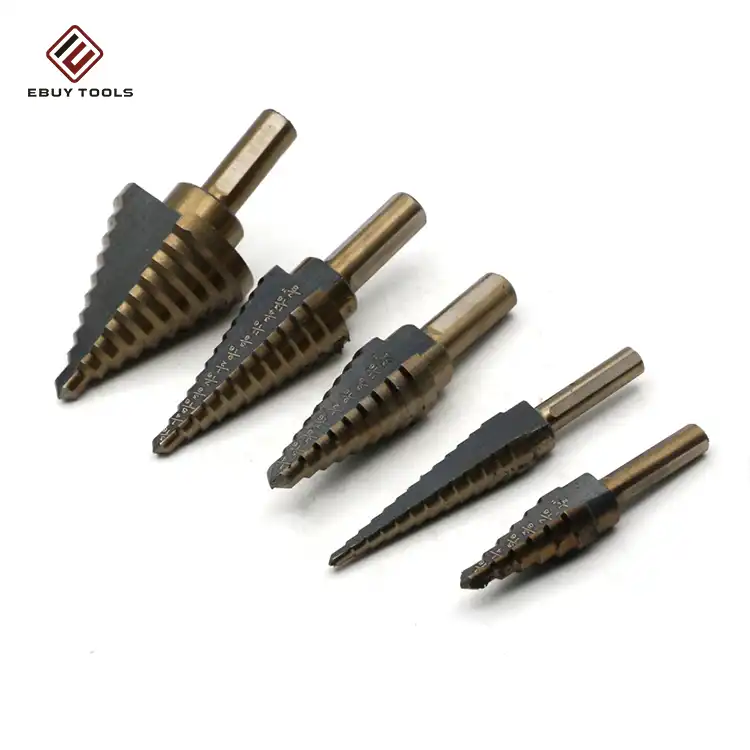
To choose the right step drill specifications, you need to match the tool's powers to the needs of the task, not just pick the highest performance grades. Our HSS step drill bits at Ebuy Tools are designed with stability in mind. They have a split-point shape that centers itself at 118°, spiral flutes that help chip clearance, and hexagonal shanks that stop rotational sliding. The 15-step setup with a diameter range of 4 mm to 32 mm can handle most metalworking tasks with a single tool, giving you the most operating freedom while reducing the complexity of your inventory.
Choosing the coating is another choice that affects both the steadiness and the life of the tool. Uncoated bits work best in situations where there is a lot of water and not a lot of production. On the other hand, TiN-coated bits are worth the small extra cost because they have less friction and last longer on the edge. Coated casting is very helpful for factories that work multiple shifts because it lowers the number of times they have to change the tools and makes the quality of the holes more uniform over long production runs.
Procurement Tips: Choosing and Maintaining Stable HSS Step Drill Bits
Buying and Maintaining Stable HSS step drill bits: Procurement Advice. Making smart choices about where to get tools and following the right repair steps will help you get the most out of your investment while also making sure that the drilling is stable across all production operations.
Technical Specification Evaluation
Before committing to a large purchase, the accuracy of the dimensions should be checked. Consistency in step height affects the accuracy of the hole diameter, and the degree of concentricity between the shank and cutting edges sets the runout traits that affect stability. Reliable makers give thorough specs, such as tolerance ranges for important measurements, so that you can compare the products of different suppliers in an informed way. At Danyang Ebuy Tools, we make sure that every bit meets our strict quality control standards before it is shipped by checking the accuracy of the step progression, the shape of each point, and the coating thickness.
The approval paperwork for the material proves the exact HSS grade makeup and the heat treatment parameters that affect the balance of hardness and toughness. This is especially important when looking for important jobs where a broken tool could damage expensive parts or put people in danger. Certificates of conformance make it possible to track and be responsible for goods, which are very important in regulated industries like aircraft or medical device making.
Supplier Reliability Assessment
When setting up tooling supply chains to support continuous manufacturing processes, production capacity and consistent wait times are very important. Our manufacturing plant is 77,000 square meters and can make more than 150,000 pieces every day. This means that we can reliably meet large volume needs, and our 319 skilled workers have a lot of experience with both standard production and meeting unique customer needs. This manufacturing size gives supply security that smaller operations can't match. This lowers the risk of buying things that are out of stock or won't arrive on time.
Technical help is what sets truly capable sellers apart from simple distributors. Application engineering help can help you find the best cutting settings for different combos of materials, and troubleshooting help can fix stability problems by looking at the problem in a methodical way instead of just replacing the product. Our R&D staff works with customers who have difficult drilling tasks to create custom solutions that meet their specific needs. This creates partnerships that go beyond simple buying and selling relationships.
Maintenance and Tool Life Extension
Implementing organized upkeep routines greatly increases the useful life of a tool while keeping its steadiness over time. A visual check before each production run finds any clear damage or excessive wear that means the tool needs to be thrown away. This keeps quality problems from happening because the cutting edges aren't sharp enough. Cleaning the flutes of built-up material layers keeps the chip evacuation system working well, which has a direct effect on the regularity of the cutting force and how the heat is managed.
Premium step drills can get their cutting performance back after being reconditioned by an expert sharpening service. However, because of their complicated geometry, this is harder to do than with standard twist drills. The costs of resharpening vs. replacing depend on the cost of the tools and the rate of work. For higher-grade cobalt tools, it's usually more cost-effective to recondition them, while for standard HSS bits, it's usually cheaper to replace them. Using real cost analysis instead of assumptions to make decisions lowers the total amount of money spent on tools across all facility activities.
Conclusion
When drilling with step drill bits, stability rests on choosing the right tools, making sure the cutting conditions are just right, and setting up the machine carefully. Knowing how the type of material, coating technology, and physical design features affect the features of a workpiece helps you make smart purchasing choices that balance cost with performance needs.
Case studies from real life show that paying attention to these factors—along with selecting a proper HSS step drill bit for specific applications—leads to measured changes in the quality of holes, the life of tools, and the efficiency of production in a wide range of industrial settings. Regular maintenance and systematic parameter tuning keep tools stable over their entire useful lives. This maximizes the return on investment in tools while keeping the accuracy and consistency needed in modern production.
FAQ
What causes an HSS step drill bit to wobble during operation?
Most of the time, wobbling is caused by too much spindle runout, not closing the chuck enough, or worn cutting edges that create uneven forces. Before tightening to the stated pressure, make sure that the hexagonal shank fits all the way into the chuck. If the shaking keeps happening with more than one bit, check the state of the spindle bearings. Radial play greater than 0.02mm causes instability that can't be fixed by changing the tools alone.
How do I determine the correct RPM for my specific material?
The best cutting speeds depend on how hard the material is and how well it transfers heat. To keep from work-hardening, stainless steel needs 300–500 RPM, while aluminum can handle 1500–2000 RPM. At 800-1200 RPM, mild steel works well. Keep an eye on the color and shape of the chips. Blue chips mean there is too much heat and the speed needs to be slowed down, while powdery chips mean the speed or feed rate isn't right.
Can cutting fluid selection affect drilling stability?
The type of lubricant has a big effect on both temperature control and chip evacuation. Water-soluble coolants are great at getting rid of heat from metal materials, while straight oils are better at keeping aluminum from sticking because they are more lubricious. When there isn't enough lube, temperature spikes happen, which makes cutting edges softer and encourages the formation of built-up edges, both of which make drilling operations less stable.
Partner With Ebuy Tools for Superior HSS Step Drill Bit Solutions
Work with Ebuy Tools to get the best HSS step drill bit solutions. If your drilling activities are having trouble with stability, you need options that are backed by manufacturing know-how and proven product quality. Our 77,000-square-meter factory at Danyang Ebuy Tools Co., Ltd. uses advanced metals and precise production to make HSS step drill bits that are designed for tough industrial uses.
Our 15-step configuration with hardness ratings of 62–64 HRC and TiN coating technology answers worries about stability by using better materials and careful design features such as hexagonal anti-slip shanks and self-centering geometry. We are a dedicated HSS step drill bit maker that works with sourcing professionals around the world. We offer expert help, the ability to make changes, and dependable supply chain support. Email our team at [email protected] to talk about your unique drilling stability needs and find out how our cutting tool options can help your manufacturing processes.
References
1. Machinery's Handbook, 31st Edition. Industrial Press, 2020. Section on Drilling Operations and Tool Selection.
2. Society of Manufacturing Engineers. "Cutting Tool Materials and Applications." SME Technical Paper Series, 2019.
3. American National Standards Institute. "ANSI/ASME B94.11M - Twist Drills and Step Drills Specification Standards." 2018 Edition.
4. Trent, E.M. and Wright, P.K. "Metal Cutting, 4th Edition." Butterworth-Heinemann Publishing, 2019. Chapter 12: Drilling and Hole Making Operations.
5. Journal of Manufacturing Processes. "Analysis of Cutting Force Stability in Multi-Step Drilling Operations." Volume 58, October 2020, Pages 341-355.
6. Kalpakjian, S. and Schmid, S.R. "Manufacturing Engineering and Technology, 7th Edition." Pearson Education, 2021. Section 23.4: Drilling and Hole-Making Processes.