.webp)

When picking out a good HSS step drill bit, you need to think about the type of material it's made of, how precisely it was made, and how well it works with the welding tools you have. The best choice has a hardness grade of between 62 and 67 HRC, the right flute shape for chip evacuation, and coating technologies that lower friction and increase tool life. By knowing these technical details and your production needs—whether you're making parts out of stainless steel or drilling through softer non-ferrous metals—you can be sure that the tools you buy will work consistently, cause little downtime, and help you reach your cost-effectiveness goals in high-volume manufacturing settings.
Understanding HSS Step Drill Bits and Their Core Features
HSS step drill bits changed the way welding was done because they got rid of the hassle of having to keep switching tools when drilling in different diameters. At Danyang Ebuy Tools Co., Ltd., we've made these conical cutting tools with diameters that get bigger over time for a huge number of precision machining shops and car providers across the United States.
What Makes the Stepped Design Unique?
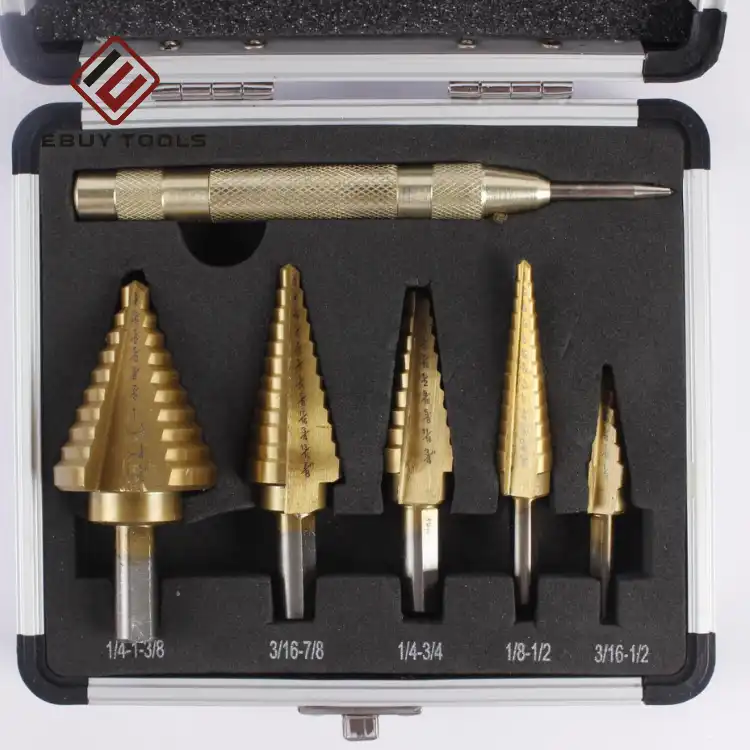
With the staircase shape, you can use a single HSS step drill bit to drill holes from 4 mm to 32 mm wide. It used to take fifteen different drill bits to do the same job, but now it only takes one step to make a perfect diameter. The self-centering 118° split-point design stops the "walking" issue that common twist drills have, especially when working with thin-walled or sheet metal materials. This design combines drilling, chamfering, and deburring into a single motion, which saves you important production time and gives you holes with no burrs that meet tight accuracy standards.
Material Composition and Performance Impact
These cutting tools are made from high-speed steel, but not all types of HSS step drill bits work the same. Our HSS 4241 tool steel is between 62 and 64 HRC hard, which means it can drill through steel, stainless steel, non-ferrous metals, and plastics without wearing down. The triangular shank keeps it from slipping inside your chuck, so the power transfer stays the same even when drilling is hard. When you're looking at the composition of a material, you should think about how different alloys affect heat resistance and edge retention. These are qualities that directly affect how long an HSS step drill bit will last in your production setting.
Interpreting Size Charts for Procurement Accuracy
Costly mistakes in buying can be avoided by understanding size requirements. Our 15-step setup includes all the steps needed to put together an electricity panel, make HVAC ductwork, or make parts for cars. The spiral-shaped flute design makes drilling in metal easier by effectively removing chips and preventing heat buildup that can cause the HSS step drill bit to become dull too soon. When looking at the technical details, make sure that the step levels match the size of the hole you need to drill and that the bit will work with the drills and portable adapters you already have.
Key Criteria for Choosing High-Quality HSS Step Drill Bits
When making your choice, you should pay attention to quality factors that can be measured and have a direct effect on business efficiency and total cost of ownership. Professional-grade HSS step drill bits are different from cheaper ones that make more problems than they fix because of their manufacturing accuracy, material treatment, and design engineering.
Steel Grade Quality and Heat Treatment
How well your HSS step drill bits work under heat stress depends on their metallurgical features. A quality of high-speed steel called "red hardness" means that it stays hard even at high temperatures. This is important for cutting stainless steel or hardened metals. At our 77,000-square-meter factory, we use controlled heat treatment steps to make sure that all of our output batches are the same hardness, between 63 and 67 HRC. When you're making a lot of things, this uniformity is important because when HSS step drill bits don't work the same way every time, it can cause problems with quality control and unplanned downtime.
Coating Technologies and Surface Enhancement
TiN treatment lowers the friction coefficient to less than 0.4, which makes HSS step drill bits last a lot longer than ones that aren't covered. The yellow titanium nitride layer makes the surface harder than 2500 HV and also shows you when the layer is wearing away. If you can see the base metal through it, you know the edge sharpness has decreased. For aircraft uses of titanium or superalloys, advanced coatings like TiAlN offer even better heat protection, but they come at a high cost that is justified by the difficult materials used.
Precision in Step Increments and Angles
Dimensional precision is what makes professional HSS step drill bits different from annoying ones with holes that don't fit the specs. To get the same results across all of your production runs, each step must keep exact height and width limits. Whether the split-point is 118° or 135°, the tip angle changes how the HSS step drill bit cuts through different materials. During production, our quality control system keeps an eye on these important measurements. Before each piece leaves our plant, it is inspected to make sure it meets ISO/ANSI concentricity standards.
Material Compatibility and Operational Parameters
If you match the HSS step drill bit to the material of the board, it won't break early and the holes will be of good quality. When drilling into steel, including stainless steel, you need to go faster than when drilling into metal or plastic. When RPM is too high, heat is released that hardens stainless steel, making a barrier that breaks cutting edges fast. Our technical specs will help you figure out the right feed rates and speeds. For example, stainless steel usually needs speeds below 500 RPM and cutting fluid. By understanding these operational factors, you can protect your investment in HSS step drill bits and keep output quality standards high.
Comparing HSS Step Drill Bits with Alternatives for Informed Decisions
The market for HSS step drill bits has a lot of different materials, and each one performs differently and costs differently. If you want to make smart comparisons, you need to know what your manufacturing setting needs and not just pick the cheapest choice.
HSS Versus Cobalt-Enhanced Alloys
Standard HSS 4241 works well for most general industrial tasks, especially when drilling non-ferrous metals, plastics, and soft steel. Types that are improved with cobalt, like M35, which has 5% cobalt, are better at withstanding heat and keeping their cutting edge quality when working with hardened materials or stainless steel. The better performance comes with higher material costs. Because of this, cobalt-enhanced HSS step drill bits are best for job shops and contract makers that work with difficult materials on a daily basis and where the extra cost is worth it for long-lasting tools.
Carbide Alternatives and Application Niches
Carbide step drill bits are very hard and can handle high temperatures, but they are also very fragile, so they can't be used in situations where there is lateral stress or shaking. Carbide is sometimes chosen by companies that make aerospace parts for high-volume production runs on automatic equipment with rigid setups that remove deflection issues. Because it is so much more expensive, carbide is not a general option for HSS step drill bits. Instead, it is used in specific situations. Most shops that do precise cutting find that good high-speed steel bits give them the best value for all of their different project needs.
Evaluating Supplier Credentials and Support Services
It's important for a brand's image to show that it makes consistent HSS step drill bits, has strict quality control, and offers help after the sale. Authorized sellers offer guarantee coverage and expert support that is very helpful when fixing problems in odd situations or finding the best drilling parameters. Our R&D department at Danyang Ebuy Tools works with clients to come up with custom solutions for their specific manufacturing problems. Our daily production capacity of 150,000 pieces ensures that our customers always have what they need. Regional dealers and tooling suppliers can save money by working with makers who keep a wide range of HSS step drill bits in stock.
Procurement Insights: How to Purchase HSS Step Drill Bits Efficiently?
Strategic sourcing changes buying HSS step drill bits from something that needs to be done to something that can give you a competitive edge. If you know how the market works, what your suppliers can do, and how to negotiate, you can get good items at a low cost.
Bulk Purchasing and Volume Advantages
When you buy all of your HSS step drill bits from a few trusted companies, you get a lot of benefits, not just lower unit costs. When you make a promise to buy a certain amount, the seller can plan your production better, which could give you access to customization options that meet your unique business needs. Setting up preferred vendor relationships with automotive providers and original equipment makers (OEMs) with multiple sites can help standardize HSS step drill bits across all locations and make inventory management easier. The production capacity of our plant allows for big orders without affecting delivery times. This is especially helpful for customers who run just-in-time manufacturing systems.
Online Platforms and Direct Manufacturer Access
Digital routes for buying HSS step drill bits make things clearer than they are with standard distribution models. When you use business-to-business platforms to contact makers directly, you can compare specs, check licenses, and ask for technical documents without having to pay a middleman. Distributors and trading businesses that sell HSS step drill bits to regional markets, where competitive pricing sets market place, will gain the most from this method. To judge a supplier's trustworthiness, you should look at their business license, quality certifications, and customer reviews that show they consistently do a good job and communicate well.
Customization for OEM and Industrial Applications
Most of the time, standard catalog HSS step drill bits work well for most uses, but sometimes, specialized industrial settings need custom solutions. Custom step configurations, private coatings, or changed shank designs can improve performance for materials or tools that are hard to work with. Our engineering team works with clients to create these unique HSS step drill bits, using our production facilities and knowledge of metals. OEM customers like how customization makes their supply chains more efficient and helps them solve technical problems that off-the-shelf goods can't fully fix.
Practical Tips for Using and Maintaining HSS Step Drill Bits
It's not enough to just choose high-quality HSS step drill bits to get the best results and longest tool life. The way the tools are used also has a big impact on the results. Using the right methods will protect your investment and keep the efficiency benefits that made you buy in the first place.
Optimizing Drilling Speeds for Different Materials
Material-specific RPM sets stop the thermal harm that causes most HSS step drill bits to break down too soon. To keep from work-hardening, stainless steel needs slower speeds and higher feed pressure. Aluminum, on the other hand, can handle faster speeds but needs sharp edges to keep the material from sticking. The right conditions for materials ranging from mild steel to high-strength alloys are laid out in our scientific standards. Monitoring the temperature of the HSS step drill bit while it is working gives real-time feedback—too much heat means the speed needs to be slowed down or the greasing needs to be better.
Maintenance Practices That Extend Service Life
When you clean your HSS step drill bits regularly, you get rid of metal chips and residue that speed up wear if you let them build up. Checking flutes for damage or built-up material is a good way to find problems before they affect the shape of the hole. It is technically possible to resharpen by grinding the flute face, but it is hard to keep the original shape without special tools. When edge retention starts to drop, most industrial processes throw these HSS step drill bits away. However, if you store them properly in protected cases and don't hit them too hard, you can make them last a lot longer.
Troubleshooting Common Drilling Problems
Clogging usually happens because chips don't move around enough, which can be caused by fast feed rates or dull cutting edges on the HSS step drill bit. When drilling deep holes, backing the bit out every so often lets chips fall out. This keeps the bit from getting too hot and using too much cutting force, which can cause it to break early. Too much dulling too soon means there are issues with the drilling settings, differences in the hardness of the workpiece material, or not enough lubrication. By changing factors in a planned way, you can find the root causes of problems, which helps you improve your processes and get the consistent results that your quality standards require.
Conclusion
To choose high-quality HSS step drill bits, you have to weigh the technical specs against your unique manufacturing needs and your budget. The difference between professional-grade tools and cheaper ones that don't last as long or work as well is the type of material used, how precisely it is heated, the finishing technology, and the accuracy of the geometry. Understanding how these factors affect your working parameters, such as the types of materials you use, the amount of output you expect, and the quality standards you set, helps you make purchase choices that minimize initial costs while also optimizing the total cost of ownership. When you work with the right supplier, you get more than just good HSS step drill bits. You also get expert help and reliable supply, which makes you more competitive in tough industrial markets.
FAQ
How do I select the correct size range for my applications?
Look at the hole diameters you've needed for recent jobs to figure out the range you drill in most often. Our 15-step HSS step drill bit configuration, which goes from 4mm to 32mm, can be used for most metalworking tasks, such as electrical installs, HVAC manufacturing, and putting together cars. Make sure that the step levels meet your needs. For some specific tasks, you may need finer or rougher progressions.
What distinguishes HSS 4241 from cobalt-enhanced grades?
At the hardness we specify, 62 to 64 HRC, HSS 4241 works very well for basic metalworking with light steel, aluminum, brass, and plastics. Cobalt-enhanced M35 HSS step drill bits have better heat resistance, which is important for stainless steel and harder materials because they keep the sharpness of the edge even when these tough materials are heated up. Which grade gives you the most value depends on the mix of materials you use.
Can these bits be resharpened when dull?
It is possible to resharpen the HSS step drill bit technically by carefully grinding the flute face, but it is hard to keep the exact original shape without special grinding tools. Most professional businesses decide that replacing old parts is cheaper than trying to fix them because fixing them costs a lot of money and doesn't always work out. Using the right techniques and keeping up with upkeep can greatly increase the original service life.
Partner with Ebuy Tools for Your Cutting Tool Needs
Danyang Ebuy Tools Co., Ltd. blends large-scale production with engineering know-how to make reliable HSS step drill bit options for tough industry uses. Our 77,000-square-meter building and 319 trained workers make more than 150,000 pieces every day, so you can always count on us to meet your production needs. Our quality control systems and ability to make changes will help you succeed whether you're a precision machining shop looking for low-cost tools or a dealer building goods for local markets. Get in touch with us at [email protected] to talk about your needs and find out why top makers choose Ebuy Tools as their HSS step drill bit provider.
References
Stephenson, D.A. and Agapiou, J.S. "Metal Cutting Theory and Practice, Third Edition." CRC Press, 2016.
Trent, E.M. and Wright, P.K. "Metal Cutting, Fourth Edition." Butterworth-Heinemann, 2000.
Kalpakjian, S. and Schmid, S.R. "Manufacturing Engineering and Technology, Seventh Edition." Pearson Education, 2014.
Shaw, M.C. "Metal Cutting Principles, Second Edition." Oxford University Press, 2005.
ASM International Handbook Committee. "ASM Handbook Volume 16: Machining." ASM International, 1989.
Boothroyd, G. and Knight, W.A. "Fundamentals of Machining and Machine Tools, Third Edition." CRC Press, 2006.