.webp)

Diamond cutting discs are a huge step forward in industrial cutting technology. They work with materials that regular abrasive wheels would quickly wear down because they contain synthetic diamond particles within metal matrices. When working with reinforced concrete, granite blocks, or high-density ceramics, these precision tools perform better than aluminum oxide wheels. For example, cutting speeds are 40–60% faster, and the tools last three times longer in normal masonry applications. The diamond cutting disc does this through controlled abrasion. As the metal bond wears away during use, new diamond crystals keep showing themselves, which keeps the cutting action active for the whole life of the tool. This self-sharpening feature solves one of the most important problems in metalworking and construction: balancing the original investment against the total cost of ownership while meeting tight tolerances for aerospace components or getting clean edges for mold cavity machining.
Understanding Diamond Cutting Discs: Types and Functions
Industrial diamond discs work by combining synthetic diamond grit, metallic bonding agents, and precisely engineered core geometry in a complex way. Diamond particles maintain their crystalline structure even when they are under a lot of pressure and heat, while silicon carbide or aluminum oxide abrasives fracture and dull rapidly when they encounter hard aggregates.
During the production process, cobalt, copper, or iron-based powders are sintered with diamond particles at temperatures above 800°C. This makes a hybrid material with diamonds that stick out slightly from the metal matrix. As the diamond is cut, the softer metal bond slowly wears away, revealing new diamond edges and stopping premature segment loss. This controlled wear pattern is what makes diamond tools keep their cutting rates the same over their entire useful life. This is an important factor when figuring out production costs in high-volume automotive manufacturing or precision mold work.
Segmented Diamond Blades
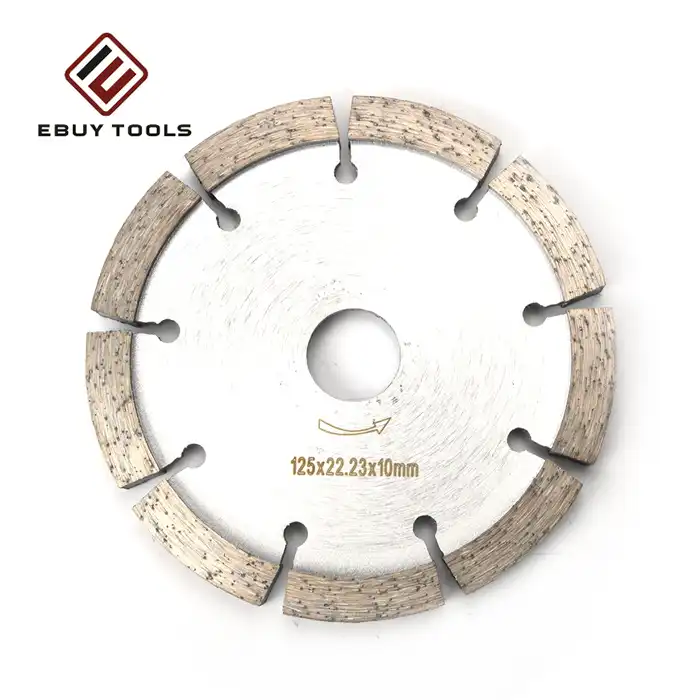
Segmented designs have different cutting areas that are divided by gullets. This makes it easier to remove debris during dry cutting operations. The holes between the segments do two things: they help cool the cutting edge by letting air flow around it, and they also let swarf escape when cutting through thick concrete sections or composite materials with steel support.
These blades work great for demolition jobs where getting rid of material quickly is more important than having a nice edge finish. When working with 12-inch reinforced concrete walls or making expansion joints in industrial floors, segmented blades give your crew a strong way to cut without the glazing problems that come up with continuous rim designs when the job is dry. The depth of the gullet directly affects how well it cools. Deeper channels are better at removing heat, but they also lower the area where segments bond, so engineers have to be careful to find the right mix.
Continuous Rim Diamond Discs
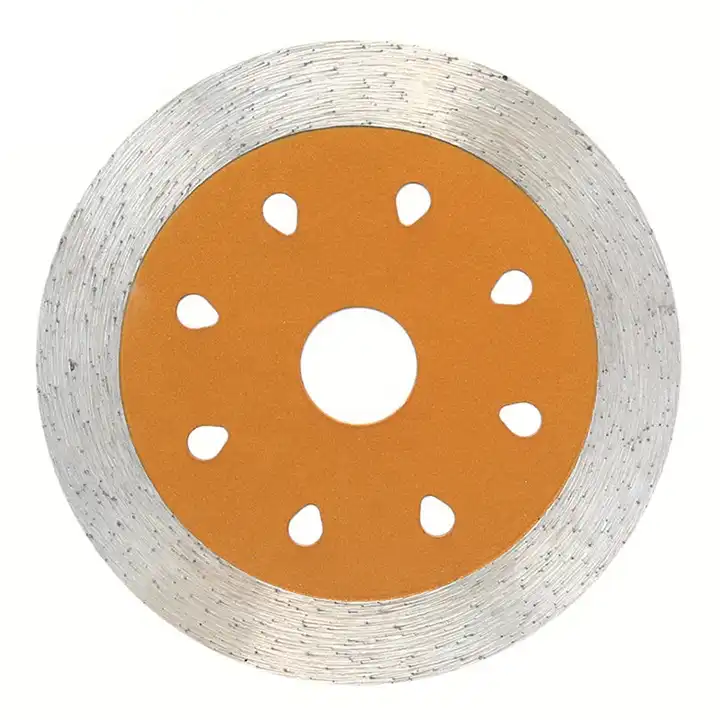
Continuous rim shapes give you a cutting edge that doesn't break, putting quality of the surface finish ahead of cutting speed. When working with fragile materials like ceramic tile, glass, or natural stone veneers, where edge quality directly affects how the installation looks, the smooth diamond-impregnated rim keeps chips to a minimum.
Professional stone makers use continuous rim blades to make tabletop edges and matched stone inlays. When doing these jobs, even tiny chips can be seen as flaws when the stones are closely examined. Because there are no segments, the vibration amplitude is lower, which allows for precise cuts within the ±0.5mm limits needed for making medical devices or aerospace components. With continuous rims, water cooling is necessary because the constant contact creates a lot of frictional heat that needs a steady flow of coolant to keep the core from bending or the segments from delaminating.
Turbo Diamond Cutting Discs
Thanks to its sharpened continuous margins, turbo edge technology fills the performance gap between segmentation and continuous rim designs for the diamond cutting disc. This hybrid design has the smooth cutting action of continuous rims and air ducts that make it easier to get rid of debris and control temperature. The castellated edge design makes pressure points in certain areas that speed up the rate at which material penetrates without compromising the structure of the edge.
This way of thinking about engineering is shown by our Turbo Diamond Cutting Disc from Danyang Ebuy Tools. These discs are made with hot-pressed sintering technology and precision-tensioned steel cores. They can easily work at speeds of up to 80m/s—a critical specification for high-RPM angle grinders used in metalworking shops and CNC machining environments. The continuous serrated edge raises the cutting pressure, and the built-in channels improve airflow, which stops the heat expansion that causes core bending in long production runs.
When your business needs to be flexible with different types of substrates, turbo discs are a clear winner. Testing results show that turbo designs keep cutting rates within 15% of segmented blades on concrete while producing edge finishes similar to continuous rims on granite. This range of performance limits the need for job shops to keep as much inventory on hand. The shape of the protected teeth stops undercutting, which happens a lot when working near rebar or when the blade level is too deep.
Technical Specifications and Standards
Before making a purchase choice, you need to know how the size and weight of the materials affect how well they work. The highest cutting depth depends on the diameter of the disc. For example, a 7-inch blade can go about 2 inches deep, while 14-inch industrial discs can go 5 inches deep for deep slab cutting or large-diameter core drilling.
Matching the bond strength is an important selection factor that is often missed in the first reviews. When you put soft bonds on hard things like granite or finished concrete, the bonds wear away quickly, revealing new diamonds all the time. When the base is soft, like asphalt or green concrete, hard bonds work best because the diamonds don't wear away too quickly. If you choose the wrong bond, it will either cause fast segment wear (soft bond on soft material) or glazing, where diamonds get lost in the matrix (hard bond on hard material). Either way, it will be very expensive.
Diamond concentration, which is given in carats per cubic centimeter, is directly related to how hard the diamond is to cut and how long it will last. Higher concentrations—usually 25–30% in premium blades—allow for longer periods of use before replacement, which is an important factor when figuring out the total cost of ownership in high-volume production settings like making automotive manufacturing or aerospace components.
Certifications from the industry back up boasts about safety and efficiency. Following EN 13236 makes sure that European safety standards for maximum running speeds and burst resistance are met, while OSHA rules require certain ways of working. When looking at a supplier's skills, checking these licenses keeps you safe from getting low-quality goods that could cause accidents or stop production.
How to Choose the Right Diamond Cutting Disc for Your Needs?
To choose the best cutting options, you have to carefully look at a lot of different factors and make decisions based on a balance of short-term performance needs and long-term running costs. This framework gives procurement managers and production engineers the confidence to successfully handle technical specifications, making sure that the tools they choose are in line with the properties of the material, the compatibility of the equipment, and the expected production volume.
Defining Application Requirements
Material recognition is the first step in choosing the right disc. Cutting grade 60 rebar-filled reinforced concrete needs a different cutting geometry than cutting natural stone or ornamental concrete that isn't reinforced. The type of aggregate in concrete has a big effect on how blades wear down. For example, river rock aggregates wear down blades less than crushed granite aggregates, which could double blade life if the bond strength is right.
Cutting depth and frequent needs have a direct effect on the choice of size and quality tier for a diamond cutting disc. Cutting to a depth of 1 inch once in a while is worth a different amount of investment than cutting continuously to a depth of 4 inches through composite materials. When you need to make more than 50 linear feet of cuts every day, premium-level blades with higher diamond ratios give you better cost-per-cut numbers, even though they cost more to buy at first.
Evaluating Bond Hardness and Diamond Concentration
The bond matrix is where the diamond particles and cutting forces meet and interact in a very important way. Professional-grade blades use carefully mixed metal powders that keep the diamond in place while also controlling the rate of loss. When cutting hard quartzite or high-PSI concrete, where strong material removal speeds up bond wear, soft bonds (usually copper-heavy formulas) work best. Medium bonds are flexible and can be used in a variety of situations, making them perfect for job shops that work with different materials. When there isn't much wear on soft materials like limestone or brick, hard bonds work best because they keep diamonds in place better.
Specifications for diamond concentration show what kind of results to expect. Basic industrial blades usually have 20 to 25 percent diamond by volume and are good for light-duty tasks or cutting soft materials. Premium manufacturing-grade discs have 30–35% concentrations, which is why they are used in aerospace components machining or precision mold work, where the regularity of the cuts directly affects the requirements for margins and surface finish.
Assessing Tool Compatibility and Safety Parameters
Mounting arbor specs must match exactly—a 7/8-inch arbor blade can't be safely mounted on a 1-inch spindle without the right reducers, and runout situations that aren't matched are dangerous. The maximum allowed RPM must be faster than the speed at which your tool can be used by a sufficient amount. When angle grinders are set to 10,000 RPM, choose discs that are designed for at least 12,000 RPM to handle short changes in speed and make sure you follow safety rules.
The cutting accuracy and kerf width are affected by the thickness of the blade. Thin-kerf designs (usually 0.06-0.08 inches) cut down on material waste and cutting resistance, which is helpful when working with expensive materials like titanium alloys or when tight standards require little kerf adjustment. Standard-thickness blades (0.1-0.125 inches) are more stable on the side and can be used for general tasks where small differences in size are okay.
Balancing Performance Against Total Cost of Ownership
When doing a full cost analysis, initial buy factors are just one part of the process. A blade that costs three times as much but cuts 300 linear feet versus one that costs half as much but only cuts 100 feet is a strong example of value. Figure out the cost-per-linear-foot measures using real-world material conditions. Manufacturer claims are often based on ideal lab conditions, not field performance where operator skill and equipment condition can change.
When evaluating a supplier, more than just the product specs are looked at. Technical support, guarantee terms, and the stability of the supply chain are also looked at. When production plans need tools to be available all the time, source capacity is just as important as product performance. Our factory at Danyang Ebuy Tools can make more than 150,000 diamond blade pieces every day. This makes sure that we always have enough material for high-volume operations in the aerospace, automobile, and general manufacturing sectors. This level of production, which is backed by 319 trained workers working in modern buildings spanning 77,000 square meters, ensures a supply chain that smaller manufacturers can't.
Warranty terms show that the company that made the product is confident in its longevity. Comprehensive warranties that cover premature section loss or core failure show that the quality control process is very strict, while restricted warranties suggest that performance may vary. Having access to technical support, like being able to talk to application engineers when working with strange materials or cutting problems, is very helpful for businesses working on a variety of projects.
Practical Guide: How to Use and Maintain Diamond Cutting Discs?
Good operating practices for the diamond cutting disc have a direct effect on how well the blades work, how safe the operators are, and how much the whole process costs. The methodical approach described here includes mounting steps, cutting methods, upkeep schedules, and fixing plans that make the tool last as long as possible while keeping the quality of the cuts throughout its use.
Safety Equipment and Operational Preparation
Wearing safety gear is the first line of defense against cutting dangers. When dry-cutting concrete or masonry, you have to wear respirators rated for silica dust because crystalline silica exposure poses major long-term health risks that standard dust masks can't properly address. Safety glasses with side shields protect your eyes from projectile debris. Hearing protection is still needed when angle grinders are running at high RPMs for long periods of time, as the noise level usually exceeds 100 decibels while cutting.
When attaching blades, it's important to pay close attention to the pressure and orientation requirements. The arrow on the blade cores must line up with the turn of the spindle. If the mounting is done backwards, the section will break right away, which is very dangerous. Mounting edges must fit tightly against blade surfaces, with no dirt or burrs that could cause runout. Tighten the mounting nuts by hand, but don't over-torque them. If you do that, the blade cores or segments could bend or crack, especially with thinner-kerf designs.
Cutting Techniques for Optimal Performance
Approaches that are tailored to the material improve effectiveness while protecting the blade's structure. When cutting reinforced concrete, move the blade slowly through the first contact. Forcing fast entry causes the section to overheat and wear out too quickly. Maintain a steady feed pressure that cuts smoothly without slowing down the motor. Too much force builds up heat that weakens diamond bonds, while not enough pressure leads to glaze, where diamonds become smooth instead of breaking to reveal new edges.
When working with thick materials like granite or high-PSI concrete, wet cutting methods make the blade last a lot longer. A steady flow of water—usually between 0.5 and 1 gallon per minute—directed at the cutting edge removes swarf and keeps temps below the point where metal bonds start to weaken. If it's still not possible to cut with water, use sporadic cutting cycles. Cutting for 15 to 20 seconds at a time, followed by short cooling times, stops the buildup of heat that can cause segments to separate or cores to warp.
Controlling the depth of cut affects both how well it cuts and how long the blade lasts. Shallow passes produce less contact heat but need more than one cutting cycle, while deep cuts get the most out of a single pass but put more stress on the material. The best depth is usually between one-third and one-half of the blade's diameter. For example, a 7-inch blade works best at 1.5-2.5-inch depths, which balance the rate of material removal with the amount of heat that can be handled.
Maintenance Protocols and Inspection Procedures
Cleaning on a regular basis gets rid of built-up debris that makes cutting less effective. After each use, use brass brushes to remove any finished concrete or mortar buildup from the segments. Steel brushes could damage the diamond exposure designs. By looking at the wear patterns on segments, you can tell what needs to be changed in the operation. For example, uneven wear around the blade's edge could mean that the equipment is out of alignment and the spindle bearings need to be checked, and fast wear on one segment side could mean that there is too much horizontal pressure during cutting.
When blades get glazed because they weren't matched properly or weren't cooled enough, dressing methods bring back the cutting efficiency of a diamond cutting disc. By drawing the blade through soft, abrasive bricks or special cleaning stones, you can break up hidden diamonds and reveal new cutting edges. When glazing happens early in the operational time, this repair step restores performance without replacing the blade. This makes the service life longer.
Replacement signs stop use from going beyond what is safe for operation. Cutting the height of a segment to less than 2 mm weakens the structure and raises the risk of breakage. Core damage like obvious cracks, coloring from heat, or warping means that the product needs to be replaced right away; continuing to use it could lead to a catastrophic failure. Unusual noise or shaking during operation is a sign of problems that need to be looked at right away.
Troubleshooting Common Performance Issues
Most of the time, bond mismatch or too much cutting pressure cause segments to wear out quickly. When blades wear out a lot faster than the manufacturer's instructions say they should, compare the hardness of the material to the bond pick and lower the feed pressure to let the diamonds get enough contact. On the other hand, glazing where the blade stops cutting efficiently means that the bond hardness is too high for the material. Performance can be restored by moving to softer bond formulations or following the right polishing methods.
Cutting processes are less precise and safer when there is too much shaking. Some possible reasons are bad mounting that causes runout, broken flanges that let the blade move side to side, or damage to the blade from previous hits. Problems with shaking are usually fixed by systematically checking everything, starting with remounting the blade on cleaned flanges. If the problem persists, the blade needs to be replaced or the equipment spindle needs to be checked.
Loss of a segment during regular operations, besides damage from impacts, is a sign of poor quality or violations of operational parameters. Check that the highest rated RPM is higher than the tool's working speed by an appropriate amount, make sure the tool is properly cooled when the specifications call for wet cutting, and check that the cutting depth stays within the acceptable range. When segment loss happens despite following the right operating procedures, contact the supplier's technical support to find out if problems with the material batch or application mismatches caused the failure.
Conclusion
Diamond cutting disc technology is always changing to meet the higher standards of accuracy needed in metalworking, aerospace components manufacturing, and other specialized industry fields. To find the best options, you need to look at the characteristics of the materials, the factors of operation, and the total cost, not just the initial purchase prices. The differences in performance between segmented, continuous rim, and turbo designs are due to basic engineering trade-offs between cutting speed, edge quality, and thermal management. Knowing these relationships lets you make confident specification decisions that are in line with your operational priorities.
Correct working procedures and maintenance schedules have a huge effect on how well blades work and how long they last. Buying the right safety gear, following the suggested cutting methods, and following set checking processes will keep workers safe and production going while getting the most out of the money spent on tools. As manufacturing processes get better at using harder materials and tighter tolerances, it becomes more important to work with suppliers who offer both high-quality goods and full expert support. This is because it helps you stay competitive and efficient.
FAQ
What distinguishes diamond cutting discs from conventional abrasive wheels?
Traditional abrasive wheels use aluminum oxide or silicon carbide grains, while diamond discs use synthetic diamond particles—the hardest known material—inserted in metal matrices. Due to this basic difference in materials, diamond tools can cut through much harder materials than regular abrasives, like reinforced concrete, granite, and ceramics, and they can keep cutting well for three to five times longer.
How long do diamond cutting discs last in places where they are used a lot?
Service life depends a lot on the strength of the material, the choice of bond, and how it is used. When cutting heavy-duty concrete with the right cooling and method, good segmented blades can usually cut 200 to 400 linear feet before they need to be replaced. When cutting factors match blade specs, premium turbo designs with optimized diamond concentrations can go over 500 linear feet. However, these hopes are greatly lowered by very hard aggregates or bad technique.
Is it safe for the same diamond blade to cut different kinds of material?
While turbo designs are pretty flexible when it comes to different types of materials, for best performance, blade specs should be matched to the main cutting tasks. When you use blades made for concrete on metal, they get too hot and wear out quickly, and metal-cutting tools don't work well on building materials. Operations that deal with a lot of different surfaces should keep application-specific blades on hand instead of using blades that can be used for more than one thing, which can hurt performance.
Partner with Ebuy Tools for Premium Diamond Cutting Solutions
When you shop at Ebuy Tools, you can find diamond cutting discs that are made for high-volume production and precise manufacturing. The Turbo Diamond Cutting Disc we make uses advanced hot-pressed sintering technology and a self-cooling turbo edge design to cut through reinforced concrete, granite, and high-density masonry with long-lasting performance. We provide stable supply security for automakers, aerospace components makers, and precision tooling operations all over North America. Our daily production capacity is over 150,000 pieces, and we have strict quality control processes in place.
Our engineering team can help you find the best blade specs for your unique material needs and production parameters through personalized consultations. Our OEM capabilities and flexible contract terms make it easy for businesses of all sizes to get what they need, whether they need standard catalog solutions or custom formulations for specialized applications. You can email our technical support team at [email protected] to get free samples, full performance data, or price quotes for large orders. As a well-known company that makes diamond cutting discs, we're dedicated to giving your operations the accuracy, stability, and application support they need.
References
Diamond Tool Technology and Manufacturing Processes, Society of Manufacturing Engineers Technical Publication, 2021.
Advanced Materials Cutting: Principles and Applications for Industrial Diamond Tooling, Journal of Materials Processing Technology, 2022.
Comparative Performance Analysis of Diamond Cutting Tools in Concrete and Stone Applications, Construction Equipment Magazine Industry Research Report, 2023.
Safety Standards and Operational Guidelines for Abrasive Cutting Tools, Occupational Safety and Health Administration Technical Manual, 2022.
Bond Matrix Engineering and Diamond Distribution Optimization in Sintered Cutting Tools, International Journal of Refractory Metals and Hard Materials, 2023.
Cost-Benefit Analysis of Diamond Versus Conventional Abrasive Tooling in Manufacturing Environments, Industrial Production Economics Quarterly, 2022.