.webp)

When selecting the best step drill bits for metal applications, the HSS Step Drill Bit consistently emerges as a top choice for industrial metalworking environments. These specialized tools combine versatility, precision, and cost-effectiveness, allowing machinists to drill multiple hole sizes without tool changes. High-speed steel construction delivers reliable performance across steel, stainless steel, aluminum, and copper, while advanced features like self-centering split points and spiral flutes minimize workpiece damage and maximize productivity in demanding manufacturing settings.
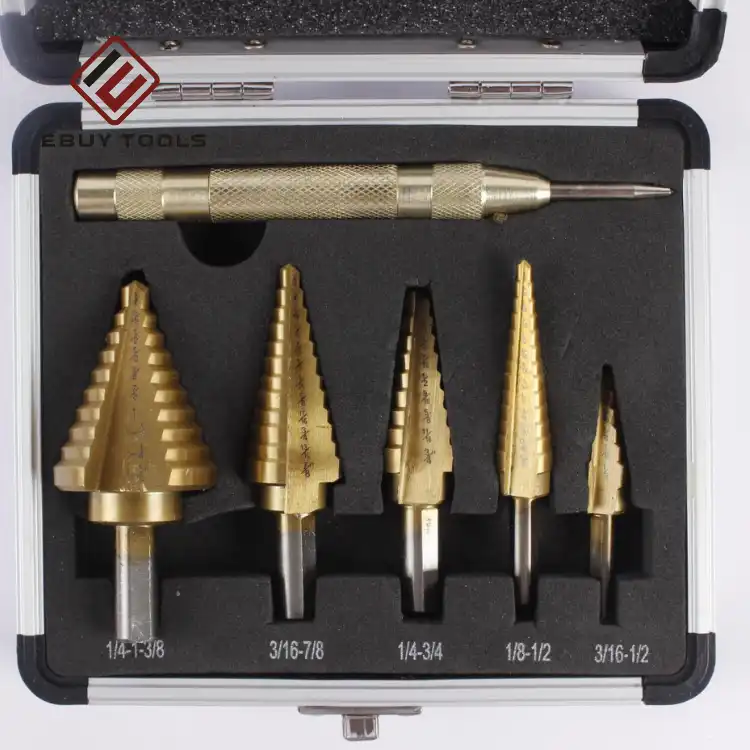
Understanding HSS Step Drill Bits for Metal Applications
HSS Step Drill Bits are a big step forward in metal drilling technology, especially for shops that do a lot of different kinds of manufacturing work. The cone shape has many stepped diameters that are arranged in smaller sizes, usually between 4mm and 32mm for professional tools. With this design, a single HSS step drill bit can be used instead of a whole set of traditional twist drills. This cuts down on the cost of keeping tools in stock and the time it takes to set up for each job.
Material Composition and Performance Characteristics
High-speed steel alloys are the building blocks of high-quality HSS step drill bits. For general use, HSS 4241 is best, while M2 or M35 grades are better for more difficult tasks. Through careful heat treatment methods, the tools we make at Danyang Ebuy Tools are hardness levels between 62 and 67 HRC. This range of hardness strikes the best balance between keeping the cutting edge and being resistant to impact. Both of these are important when drilling through work-hardened stainless steel or rough aluminium alloys.
The choice of material has a direct effect on thermal stability during long drilling operations. Metallurgists call the fact that high-speed steel keeps its hardness at high temperatures "red hardness." This keeps the edge from becoming dull too quickly when friction creates heat during metal penetration. This is especially important in high-volume production settings where continuous drilling is common.
Size Ranges and Stepped Configurations
Most professional-grade HSS step drill bits have between 9 and 15 steps, and each step represents a different diameter. The 15-step design works with the widest range of hole sizes, from small pilot holes to bigger clearance openings, without the need for extra bits. This versatility is very useful for technicians working on automotive fabrication and HVAC installation, where the hole diameter needs to be changed from one project to the next.
The distance between steps affects how well you drill and how long your HSS Step Drill Bit lasts. Closer step intervals allow for more precise control of the width, but they may make chip removal less effective. Our engineering team chooses the step spacing to get the best results in both accuracy and the rate at which material is removed. This makes sure that the cuts are clean and that the HSS Step Drill Bit and product don't get too hot, which could damage both.
Optimal Drilling Speeds for Different Metals
Choosing the right rotational speed has a big effect on how well you drill and how long your tools last. For HSS step drill bits in the 10–20 mm range, mild steel needs speeds between 500 and 800 RPM. Stainless steel, on the other hand, needs speeds between 300 and 500 RPM to keep the work from hardening. Aluminum and brass can handle speeds up to 1200 RPM, but too fast of a speed can melt the material to the cutting edges.
Feed pressure is just as important as rotational speed. When the pressure is firm and under control, the cutting edges can split the material easily without making too much friction. The HSS step drill bit should smoothly cut through each step, and if too much force is needed, the bit may have worn down, or the speed may need to be changed.
How to Use HSS Step Drill Bits Effectively in Metalworking?
When used correctly, HSS Step Drill Bits can be turned from simple tools into precise instruments that give consistent, professional results. This method of operation is very different from regular twist drill use, and operators need to know how stepped geometry works and how materials react to larger and larger diameters.
Equipment Setup and Speed Configuration
Choosing the right drilling tools is the first step to doing HSS Step Drill Bit operations well. Fixed-speed drill presses are harder to control than variable-speed ones because the RPM can't be matched exactly to the roughness of the material or the width of the hole. When used by hand, high-torque cordless drills with a minimum 18V rating have enough power to drill through sheet metal up to 3 mm thick without damaging it.
The choice of chuck has a big effect on how accurately you drill. Keyless chucks are convenient, but heavy loads may cause the HSS step drill bit to slip. Keyed chucks have stronger grips, which is important when drilling stainless steel or using the steady, firm pressure needed for smooth step changes. This problem is solved by the hexagonal shank design on high-quality HSS step drill bits, which stops the bit from rotating inside the chuck.
Lubrication and Cooling Methods
Using cutting fluid greatly increases the life of a tool and makes the holes in it better. Cutting oils with sulfur work best on ferrous metals because they limit friction and heat creation the most. Aluminum and copper alloys work well with coolants that dissolve in water. They keep chips from sticking and keep the metal lubricated. When compared to dry drilling, even simple spray lubricants are very helpful, especially when working with stainless steel that hardens quickly when heated and pressed.
How the lube is used is just as important as the lubricant itself. Continuous supply of fluid straight to the cutting edge gives the best results, but applying fluid every so often between steps is much better than leaving the area dry. Mist coolant systems deliver precise amounts of fluid to production areas while reducing mess and waste.
Maintenance and Storage Protocols
Regular cleaning right after use keeps metal chips from building up in the flutes, which can make it harder to drill in the future. A brass wire brush gets rid of debris well without hurting the cutting edges or the coating. Chips stuck between steps can cause stress concentration points that cause HSS Step Drill Bits to break before they should. Spending time cleaning thoroughly is worth it.
Long-term performance is directly affected by how things are stored. HSS step drill bits should be stored in boxes or foam inserts that protect them and keep the edges from touching other tools. Moisture speeds up rusting, especially on HSS step drill bit areas that aren't coated. A thin layer of rust-preventative oil applied before storage keeps the cutting edge sharp even after long periods of inactivity.
Comparing HSS Step Drill Bits with Other Types for Metal Use
The market for metalworking tools has a lot of different kinds of HSS step drill bits, and each one is designed to meet the needs of a certain application and budget. When procurement managers understand these differences, they can choose tools that meet their specific operational needs the best, rather than just picking the one that costs the least.
HSS Versus Titanium-Coated Performance
It is recommended to use standard HSS step drill bits for most non-ferrous and mild steel tasks because they are very versatile. Adding a titanium-nitride coating changes the surface's properties in a big way. It makes the surface much harder (up to about 2500 Vickers) and less slippery (below 0.4). This coating makes tools last three to six times longer than ones that aren't coated. This is especially helpful in work settings where downtime for changing tools has a direct effect on how well things run.
TiN-coated HSS step drill bits have a unique gold color that is used for something other than looks. This visual cue makes it easy to find coated tools in inventories of mixed tools, and it also shows wear patterns as the coating wears off. When the underlying steel can be seen at the cutting edges, operators know that the blades need to be resharpened or replaced.
Cobalt-Alloyed Bits for Demanding Applications
About 5% cobalt is added to the high-speed steel structure in M35 grade HSS step drill bits, which changes the thermal qualities in a basic way. This metal stays hard at much higher temperatures than regular HSS step drill bits, which makes it the best choice for drilling stainless steel when heat generation is necessary. The extra cost of materials compared to regular HSS step drill bits is usually between 40 and 60%, but the longer service life in tough materials usually makes up for it.
The amount of cobalt in a metal affects both its ability to resist heat and its tendency to break easily. M35 HSS Step Drill Bits can't handle as much lateral stress as standard HSS Step Drill Bits, so operators have to make sure they are perfectly aligned perpendicularly while drilling. In situations involving thin sheets of metal that are easy to keep perfectly aligned, this trade-off rarely becomes a problem.
Carbide-Tipped Options and Cost Considerations
Carbide HSS Step Drill Bits are the most expensive ones on the market. They can drill through hardened steel and cast iron because they are very hard and don't wear down easily. However, because carbide is naturally fragile, these HSS Step Drill Bits can't be used for impact drilling or other tasks where they need to bend laterally. When compared to HSS step drill bits, carbide versions are often more than 300% more expensive, making them specialized tools rather than all-purpose options.
When purchasing managers look at the total cost of ownership, carbide HSS step drill bits mostly show their worth in automatic production settings with rigid machine setups, where the extra time they last makes up for the initial cost. Job shops and production plants that do a lot of different kinds of work do better with HSS step drill bits or cobalt-alloyed bits that are more flexible and can handle the different ways that projects need to be placed.
Top Recommended Specifications for Industrial Metal Drilling
For professional manufacturing, you need HSS step drill bits that are made to strict standards, not cheap tools that put short-term cost over long-term performance. There are a few important differences between industrial-grade bits and consumer-grade bits that have a direct effect on cutting accuracy, tool life, and worker safety.
Split-Point Geometry and Design That Centers Itself
The basic shape of an HSS step drill bit tip determines how well it drills and how easy it is to use. Split-point geometry, which is usually ground at 118° or 135° angles according to DIN 1412 C standards, makes the part self-centering, so you don't have to use center punching or pilot holes. This feature comes in handy when drilling into curved surfaces or when precisely placing holes is necessary for aligning an assembly.
Normal cylindrical tips don't have this self-centering quality, so they tend to "walk" across smooth metal surfaces before they find a grip. This behavior leads to uneven placing, which lowers the quality of the assembly and could damage the parts. The technical work that went into split-point grinding pays off in increased production that more than covers the small cost difference.
Spiral Versus Straight Flute Configurations
The shape of the flute has a big effect on how well chips are removed and how smoothly the blade cuts. Spiral flutes constantly move metal chips up and out from the cutting zone. This keeps the chips from packing together, which could jam the HSS step drill bit or damage the hole wall. This arrangement also spreads the cutting forces more evenly around the bit's circumference. This lowers vibration and increases tool life by making wear patterns more uniform.
Straight-flute designs have benefits, mostly in how easily they can be sharpened again and how cheaply they can be made. When a company has its own tool-sharpening equipment, straight flutes make the grinding process a lot easier. But in production settings where changing tools costs a lot of money and time, the performance benefits of spiral flutes usually outweigh these issues.
Quality Manufacturing Standards
At our factory in Danyang, Ebuy Tools, we use strict quality control procedures at every step of the manufacturing process. Rockwell hardness tests are done on each HSS step drill bit to make sure that the heat treatment worked. The cutting surfaces should have a hardness between 63 and 67 HRC. Precision optical comparators are used to measure concentricity and make sure that rotational run-out stays below 0.05 mm. This is important for keeping chatter and vibrations from happening during high-speed drilling operations.
Spectrographic testing for chemicals makes sure that the alloy composition meets the requirements. This is especially important for M2 and M35 grades, where the exact amounts of tungsten, molybdenum, and cobalt determine how well they work. With these quality control measures, professional-grade HSS step drill bits can be told apart from cheaper options that may work very differently from batch to batch.
The method of applying the coating gets extra attention because the strength of the adhesion affects how long the covering lasts. TiN and TiAlN coatings need to be the same thickness and have molecular bonding to be able to handle the changing temperatures and mechanical stress of metal drilling. Even at the stress concentration points where steps change sizes, our process settings keep the coating's integrity.
Practical Tips and Final Recommendations for B2B Procurement
Strategic tool procurement includes more than just finding good products. It also includes managing inventory, building relationships with suppliers, and making sure that the capabilities of the tools match the needs of the production process. The following things to think about can help procurement managers make the best choices about both short-term purchases and long-term tooling plans.
Matching Tool Specifications to Production Needs
The types of materials your facility works with should be the most important factor in choosing an HSS step drill bit. Standard HSS Step Drill Bits with a TiN finish work very well in operations that mostly work with aluminum and mild steel. Even though they cost more, shops that regularly drill stainless steel grades above 304 should switch to M35 cobalt-alloyed HSS step drill bits because they last longer and require less maintenance, which results in a lower total cost of ownership.
If elite HSS Step Drill Bit types are economically valuable depends on how often they are used and how much they are made. High-volume operations can get the most out of cobalt and advanced coating choices that make the most of the pieces that can be made with each tool. On the other hand, job shops that do a lot of step drilling may find that normal HSS step drill bits are enough for their needs. Different applications have different volume thresholds at which premium tools become cost-effective. However, in general, operations that drill more than 500 holes per month see a clear return on their investment in better tools.
Supplier Evaluation and Quality Assurance
A supplier's skills have a big effect on the success of a procurement, not just the product specifications. When increasing output or dealing with problems in the supply chain, manufacturing capacity is important. Our 77,000-square-meter factory has 319 skilled workers who make more than 150,000 diamond saw blade pieces every day. This shows that we have the production depth to handle large-scale operations and meet urgent needs quickly.
Technical support is what sets suppliers who just sell products apart from partners who help your business succeed. Having access to applications engineering experts can help you choose the best HSS step drill bits for difficult materials or unique needs. When standard products don't exactly meet the needs of an application, our Research and Development department works with clients to make custom solutions.
Future Technology Trends in Step Bit Design
Coating technology keeps getting better and better. Multi-layer and nanocomposite coatings are now available that offer better performance than standard TiN formulas. TiAlN coatings are more stable at high temperatures than TiN coatings, keeping their hardness at temperatures where TiN starts to soften. These high-tech coatings make HSS step drill bits last longer and let them cut at faster speeds, which shortens run times in industrial settings.
Manufacturers can make flute configurations and step gaps that remove the most material with the least amount of cutting force by using computer modelling to optimize geometry. These changes make it possible for tools to last longer and for holes to be made better. This lets forward-thinking businesses stay ahead of the competition by making their production more efficient.
Conclusion
To choose the best HSS step drill bits for metalworking, you need to weigh performance needs, material fit, and cost factors in your unique work environment. HSS Step Drill Bits are very useful and flexible for most welding tasks, while cobalt-alloyed versions give you the performance you need for tough materials like stainless steel. Using tools correctly, like choosing the right speed and lubricating them properly, can make them last a lot longer and make sure the quality of the holes is always the same. When making reliable tooling programs that keep production going, supplier capabilities and quality manufacturing standards are just as important as product specifications. When strategic purchasing choices are made based on production numbers and material needs, both short-term costs and long-term operating efficiency are maximized.
FAQ
Can HSS step drill bits effectively drill stainless steel?
With the right method, standard HSS Step Drill Bits can drill through austenitic stainless steel types like 304, but the tool will not last as long as when drilling through mild steel. M35 cobalt-alloyed HSS step drill bits work much better in stainless steel applications and keep their sharp edges for a longer time because they can handle heat better. Keeping the spinning speed between 300 and 500 RPM and using cutting fluid all the time stops work hardening and greatly increases tool life, no matter what HSS grade is chosen.
What maintenance practices extend the step-by-step lifespan?
A thorough cleaning right after use stops chip buildup that speeds up wear and can cause HSS step drill bit seizure during later operations. Brass wire brushes get rid of metal scraps well without hurting cutting edges or coats. When stored properly in protective cases, edges don't get damaged when they touch other tools. A thin layer of oil on objects that aren't already coated stops rust while they are being stored. Watching for signs of wear, like less effective cutting or higher drilling pressure, lets you know when to resharpen or replace the tool before it fails completely.
How do I choose between HSS and cobalt step bits?
The hardest thing that matters is the material that needs to be drilled. It is very cost-effective to use HSS step drill bits with a TiN finish for general tasks that involve aluminum, copper, brass, and mild steel. When drilling stainless steel or hardened steel on a regular basis, or when a longer tool life justifies the extra cost in high-volume production, you need a Cobalt M35 variant. Companies that drill fewer than 200 holes a month in normal materials rarely get the cost savings from using cobalt back through longer tool life. On the other hand, companies that do a lot of work with stainless steel see a quick return on their investment.
Partner with Ebuy Tools for Your Metalworking Solutions
Industrial-grade HSS step drill bit options from Danyang Ebuy Tools are made for tough metalworking settings. Our industrial know-how, combined with 77,000 square meters of space for production and daily output of more than 150,000 pieces, guarantees a steady supply for your business needs. Our research & development team works with you to find the best solutions, whether you need standard configurations or specifications that are made just for you. As a company that only makes HSS step drill bits, we offer low prices and strict quality control that meets international standards. Get in touch with our team at [email protected] to talk about your unique needs and get personalised buying advice that fits with your production goals.
References
1. Machinery's Handbook, 31st Edition (2020). Industrial Press. The Drilling and Related Operations section covers step drill specifications and applications.
2. ASM Handbook Volume 16: Machining (2019). ASM International. Comprehensive coverage of high-speed steel tool materials and heat treatment processes.
3. Society of Manufacturing Engineers (2021). Cutting Tool Technology and Applications. Detailed analysis of step drill bit geometry and performance optimization.
4. American National Standards Institute (ANSI). ANSI B94.11M-1993. Twist drills and step drills dimensional standards and tolerance specifications.
5. Modern Machine Shop Magazine (2022). "Advanced Coatings for Metal Cutting Tools." Technical article on TiN and TiAlN coating performance characteristics.
6. International Journal of Advanced Manufacturing Technology (2021). "Thermal Analysis of Multi-Step Drilling Operations in Stainless Steel." Research paper on heat generation and tool wear mechanisms.